FAQ
Modular Home FAQs
Everything you need to know about BioBuilds Passivhaus certified modular homes, from construction and efficiency to pricing and delivery across Europe.
What does Passivhaus certification mean for MODULAR?
MODULAR uses a construction system certified by the Passive House Institute in Germany, with over 2,000 tracked parameters. The standard models target around 15 kWh/m² per year for heating, compared with the 350 kWh/m² reference used for older detached homes. The insulated, airtight envelope and filtered ventilation work together for low heating demand and indoor comfort.
What structure is MODULAR built on?
Passivhaus certified timber-frame system, built on 35cm structure. Exceptional strength, ground-breaking efficiency.
What insulation does MODULAR use?
High-performance STEICO wood-fiber insulation, λ ≈ 0.036 W/m·K.
What is the service life of MODULAR?
Over 85% of new homes in Sweden are built on timber-frame, with an average lifespan of 70+ years. MODULAR uses a significantly improved timber-frame structure (Passivhaus certified), fully airtight and incredibly efficient, which can significantly extend its service life. The minimum estimate is 80+ years.
Is MODULAR a permanent or temporary home?
Both are possible. Over 80% of clients choose MODULAR as a permanent home. Sanctuary 142 m² Exterior Finished is the most popular model among families.
What sizes does MODULAR come in?
The standard sizes are Wanderlust 48 m², Serenity 95 m², Sanctuary 142 m² and Bloom 190 m². Infinity is the panoramic glazing upgrade, available in the configurator. Exact dimensions and layouts are shown in the catalog and configurator.
How much does BioBuilds MODULAR cost?
Prices depend on the model, finish level and selected options. The catalog and configurator show current indicative prices. For Germany, Austria and Romania, the configurator adds an estimated transport cost once you enter your postcode; other destinations are quoted individually. Your personalised offer confirms the final scope and price.
What does the EPD cover for MODULAR?
EPD HUB-0050 covers the declared BioBuilds external wall. Its production-stage result is -101 kg CO2e per m² of wall, from raw materials through manufacturing.
Where can I verify MODULAR certificates?
On the BioBuilds website and the issuers’ public records: the Passive House Institute for the MODULAR construction system and EPD Hub for the environmental declarations.
Can MODULAR run off-grid?
Yes. Ultra-low consumption enables compact PV and battery systems for autonomy.
How does MODULAR handle earthquakes and severe weather?
It has a very high resistance 35cm prefabricated structure with ground-screw foundations to dissipate shocks and vibrations. It offers significant resilience to natural disasters.
What is the fire resistance rating?
Factory tests reach over 90 minutes on wall fire resistance. While it can vary by location, the natural resistance of the cladding and the wall's airtightness is undeniable.
How is the connection between the ground-screw foundation and the timber module handled?
A purpose-designed interface physically separates the foundation from the home and absorbs mechanical movement at every connection point. Ground screws concentrate the connection into a small number of points that are easier to insulate and control. A concrete foundation spreads the same thermal-bridge risk across an area tens or hundreds of times larger, which is why a Passivhaus concrete foundation must be fully insulated.
How is the underside of the house protected?
Beyond being fully airtight, the underside of the floor assembly includes a fine metallic protection mesh. The openings of the ventilated facade are also protected with a fine insect mesh.
Can BioBuilds provide a description of the wall, floor and roof structure?
Yes. We provide a general description of the complete building system. The patent-pending volumetric structure uses C24 timber, interior OSB made with formaldehyde-free adhesives, STEICO ultra-efficient wood-fibre insulation, a diffusion-open exterior board and an intelligent vapour-control membrane. The defining engineering advantage is three-dimensional. A conventional sandwich panel is calculated as a stack of separate layers. BioBuilds calculates the walls, floor and roof together as one volumetric structural and thermal system, eliminating active thermal bridges across the complete home.
What structural system do you use and why?
Timber frame. The most advanced building material available, timber insulates naturally, is exceptionally strong, stores CO2 instead of emitting it, and creates naturally healthy indoor conditions.
What share of organic materials does MODULAR use?
Over 98% organic materials. Your home breathes naturally, regulating humidity, purifying indoor air, and creating a living environment that conventional buildings simply cannot match.
What is the acoustic performance of the walls?
Airborne sound insulation of up to 54 dB. This is comparable to professional audio spaces.
How is vapor diffusion managed in the walls?
Controlled outward drying uses a smart membrane and carefully selected structural panels. The certified design manages moisture to prevent condensation and moisture-related damage when built and used as specified.
What cladding options are available?
Yakisugi or Lunawood. Both offer high protection and durability.
What interior finish options are available?
A full catalog of premium organic finishes is available during the design phase. These are included at no extra cost for the turnkey option, unless specified otherwise.
What is a ventilated facade?
A controlled air cavity that evacuates moisture and protects the structure long-term. Also known as rainscreen cladding.
Are kitchen services included?
Turnkey includes all installations. With Exterior Finished, cables and conduits are included as standard. Water installation and electrical panel installation are preselected and removable. Kitchen water connections are prepared when water installation is included; the electrical wiring is standard.
How is timber cladding maintained long-term?
Organic finish. Low maintenance. A typical recoat is needed every 3-6 years, versus 1-2 years for conventional synthetic finishes.
How are interior finishes maintained long-term?
Materials are selected for easy cleaning and durable, modern natural aesthetics.
What are the smart exterior blinds?
The turnkey package includes exterior textile blinds with multi-protocol smart control. They block up to 99% of UV radiation and provide wind resistance up to Class 1.
What roof pitch do you use?
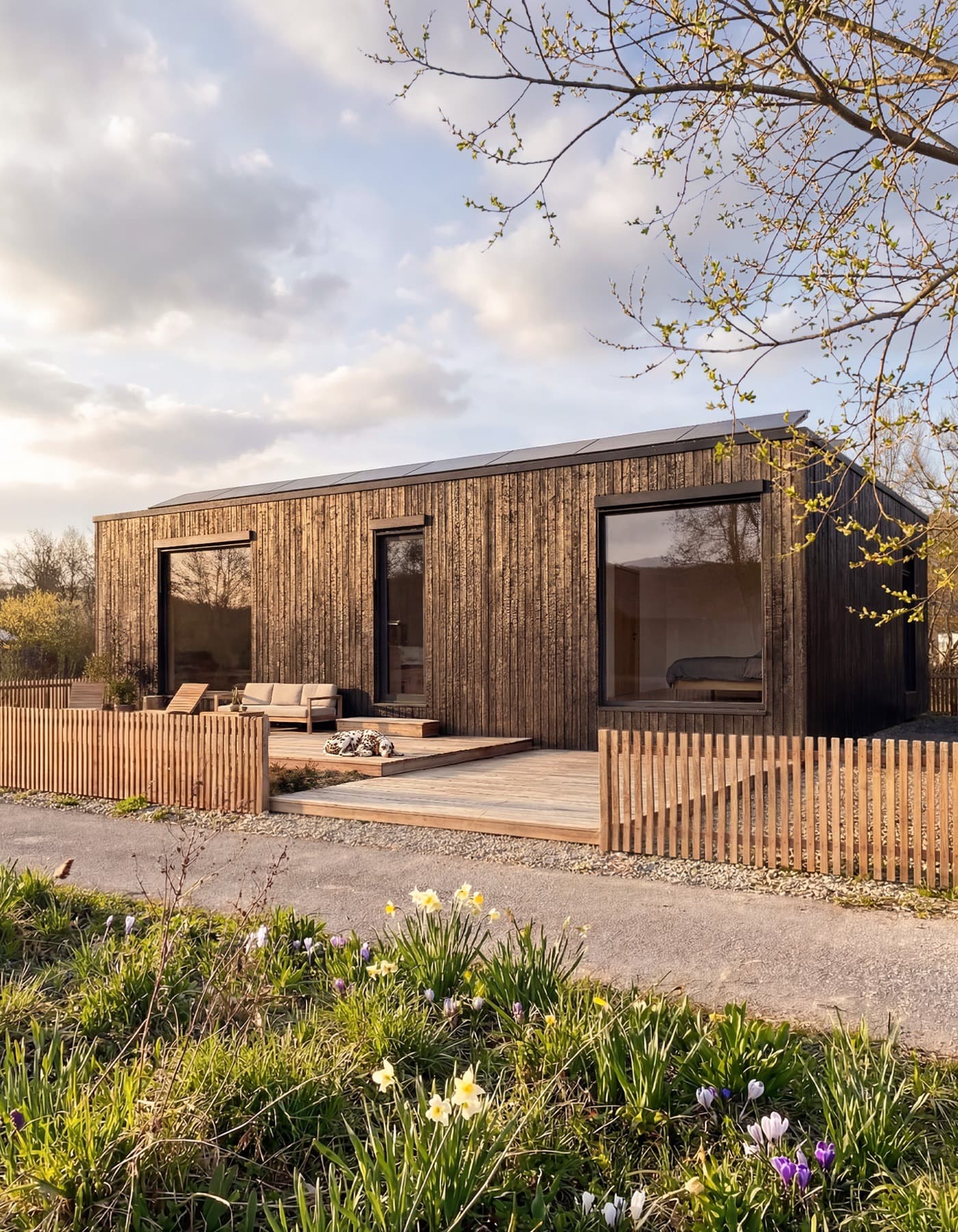
A low slope of 3–5°. This provides a flat look with efficient drainage.
Is the roof ventilated?
Yes. Ventilation reduces moisture and overheating and extends the life of the roof covering.
What roof material do you use?
EPDM membrane. Load capacity over 300 kg/m².
Is the roof suitable for photovoltaic panels?
Yes. The low-slope roof supports loads of up to 300 kg/m², almost four times the approximately 80 kg/m² capacity of a standard residential roof. Structurally, it is ready for your photovoltaic installation.
How is rainwater managed?
Concealed gutters are located within the ventilated facade. Optional collection for reuse is available.
What snow and wind loads does the roof handle?
Engineered beyond national standards for extreme loads, ensuring high safety in use. Est. at 300kg/m² for the roof load versus EU average of 80kg/m².
Can a larger hot-water tank be installed inside the technical room?
A tank above 200 L is generally unnecessary for a family household. Typical European sizing is approximately 100 to 150 L. BioBuilds uses a 100-150 L Ariston smart two-tank system. While one tank supplies hot water, the other recharges.
Where could we install a greywater tank?
A greywater tank should be installed outside. This preserves valuable space inside the home and removes an unnecessary structural load and water-damage risk.
Where should photovoltaic inverters and batteries be installed?
We recommend installing inverters and batteries outside. This keeps equipment noise and heat out of the home while simplifying servicing and connection to the external meter and main electrical supply.
Can the systems be integrated with SG Ready or a smart-home platform?
Yes, depending on the final equipment and control configuration. Most add-ons communicate through standard protocols and can be connected through a compatible relay or a platform such as Home Assistant. Some systems currently require Wi-Fi for smart integration, including the Zehnder ventilation system. We confirm every interface when the final equipment specification is established.
Does the system provide active cooling and humidity control?
Yes. In the Zehnder ComfoClime configuration, the system provides active heating or cooling while regulating indoor humidity.
Which heating and ventilation equipment is used?
The system combines centralised Zehnder ventilation and its heat-pump module with a decentralised Samsung/Panasonic heat pump for rapid temperature control. The exact models depend on the selected configuration.
How efficient is MODULAR?
It repeatedly beats the Passivhaus standard of ~15 kWh/m² per year according to Passivhaus simulations. That is roughly 20 times more efficient than the average European home, and far beyond the nZEB (nearly zero-energy building) standard. Performance varies by climate, orientation, and use.
How airtight is a BioBuilds home?
Completed BioBuilds homes achieve a benchmark-setting ~0.4 ACH on average. The Passivhaus standard requires no more than 0.6 ACH. Older, leaky homes can reach ~20 ACH.
What specific annual consumption is targeted?
According to Passivhaus simulations: Modular reaches a ground-breaking 15 kWh/m² per year. In comparison, the EU detached house average is ~350* kWh/m² per year. This ensures a dramatically lower energy consumption. Values vary with location and positioning.
How much can bills drop versus a conventional home?
Up to 95% savings. This depends on consumption, climate, and orientation.
How does it perform in summer?
Insulation, external shading and ventilation limit summer heat gain. The selected heat-pump system can provide active cooling; the required capacity depends on the climate, glazing and shading.
How does it perform in winter?
Super-insulation and smart heat-recovery ventilation maintain stable indoor comfort even during harsh winters, with minimal energy input. The home stays warm with a fraction of the heating a conventional house needs. Needs vary by climate.
What is the role of airtightness?
Airtightness limits uncontrolled air leakage. In a test at 50 Pa, older, leaky homes can reach around 20 air changes per hour. The Passivhaus limit is 0.6, about 33 times lower than that leaky-home reference.
How do the windows perform?
Triple glazed, laminated, tempered glass. Ground-breaking Ug of ≤ 0.5 W/m²K. And Passivhaus-certified ultra-efficient aluminum frames.
How are thermal bridges eliminated?
Through a volumetrically designed ultra-efficient system: MODULAR, also certified by the Passivhaus institute.
What does the BioBuilds Passivhaus certification cover?
The Passivhaus certification covers the complete BioBuilds building system, not an individual material or wall layer. More than 2,000 parameters are verified across the materials, structure, insulation, airtightness and building services specified for the home. Every part is engineered and verified as one system before the home leaves the factory. A separate certification of the completed building adds the final project-specific layer. It evaluates how the certified BioBuilds system works with the exact climate, orientation, shading and foundation of the site. BioBuilds supplies the technical system data, while the certifier confirms the performance of the finished home in its specific setting.
Can the client appoint an independent inspector or certifier?
Yes. The client may appoint an independent inspector or certifier to review the project and supervise the relevant stages.
Can technical information be provided to the client’s certifier?
Yes. We provide the technical data relevant to the Passivhaus-certified BioBuilds system.
Can a blower-door test be performed after installation?
Yes. Airtightness is checked during factory production at defined stages. A blower-door test of the complete home can also be arranged after installation, with the client or independent inspector present. The additional cost depends on the project location and logistics.
Is a structural engineer required in Germany?
As with any building in Germany, the requirements depend on the site. A site-specific structural calculation and review by a certified body are generally required.
What is MODULAR’s CO2 impact?
The declared external wall has a carbon-negative production-stage result of -101 kg CO2e per m², as recorded in EPD HUB-0050.
What does the EPD calculation include?
EPD HUB-0050 covers raw materials and manufacturing, end-of-life scenarios, and benefits beyond the product system. Transport to site, installation and the use phase are not declared.
Where do key materials come from and how are they certified?
Almost the entirety of MODULAR's organic structure is sourced from Europe, specifically Germany, Austria and Romania.
How much is recyclable or reusable at the end of life?
With over 98% organic content, a large share is recyclable or reusable.
Do you offer buy-back or refurbishment programs?
Such programs are under evaluation as part of our circularity strategy.
What is the on-site waste level?
Near zero. 99% is factory-prefabricated for a clean site and reduced impact.
What VOC emissions do the materials have?
Materials are selected for minimal VOCs. Interior smooth ECO OSB with near-zero formaldehyde is used for clean indoor air.
How does the system prevent condensation and mold?
The certified envelope combines airtightness, controlled outward drying and thermal-bridge detailing, while ventilation removes indoor moisture. Together they prevent moisture problems under the specified design and operating conditions.
What filtration does the heat-recovery ventilation provide?
Zehnder ventilation system filtration. It captures dust, pollen, and allergens. A full air refresh occurs roughly every 2 hours.
How do natural materials affect indoor air quality?
Organic materials buffer humidity and support daily breathing comfort.
What quality checks occur before delivery?
MODULAR is tested to meet both all discussed local standards as well as the incredibly strict Passivhaus System certification metrics.
What is the average factory production time for each model?
Average production times: Wanderlust: 3 days. Serenity: 5 days. Sanctuary: 7 days.
How does prefabrication ensure tight tolerances and precision?
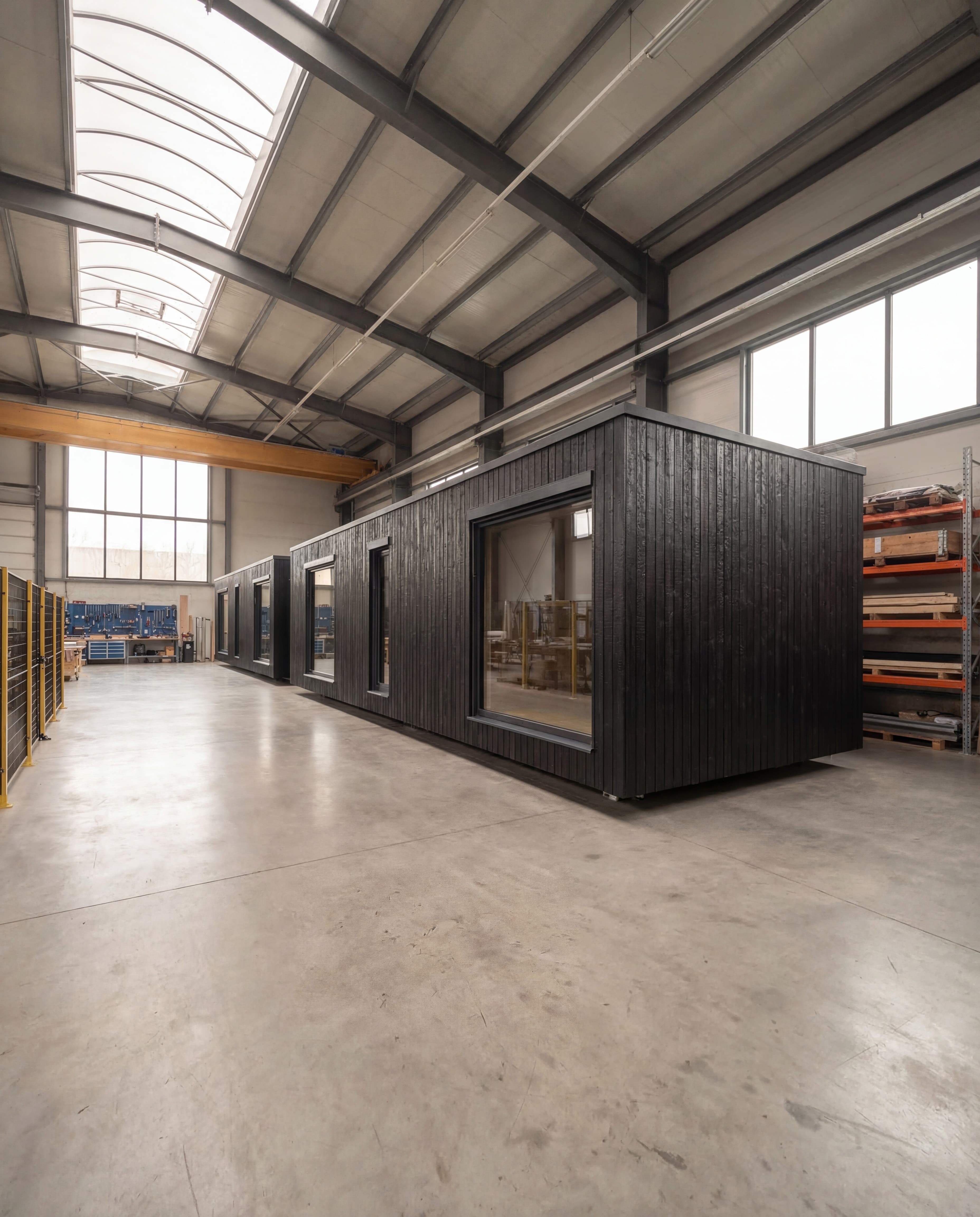
Through LEAN processes, Passivhaus standards, and EU regulations. 99% of the work happens in the factory under controlled conditions.
Can a completed BioBuilds home be visited?
Yes. The most useful reference is one that resembles your own project. We identify the closest relevant completed home, confirm availability with its owner and coordinate a private visit. You can also visit the BioBuilds factory to inspect the materials, building system and production process before a home leaves the factory.
What are the steps from reservation to move-in?
10% to reserve your offer, 40% for materials, 40% for production and 10% at delivery. The material and production payments complete your production reservation, subject to readiness and available slots. Inspection takes place on the trailer before unloading.
Do you support permitting and technical documentation?
In specific areas across Europe, we collaborate with local architects to simplify the process. If the area isn't covered by our collaborators, we can collaborate with the local architect directly for most projects.
Who prepares the foundation and utilities on site?
The client handles foundation preparation and utilities with licensed contractors. The home is compatible with ground screws, concrete slabs, and other standard foundation types, as long as they do not compromise the efficiency of the home.
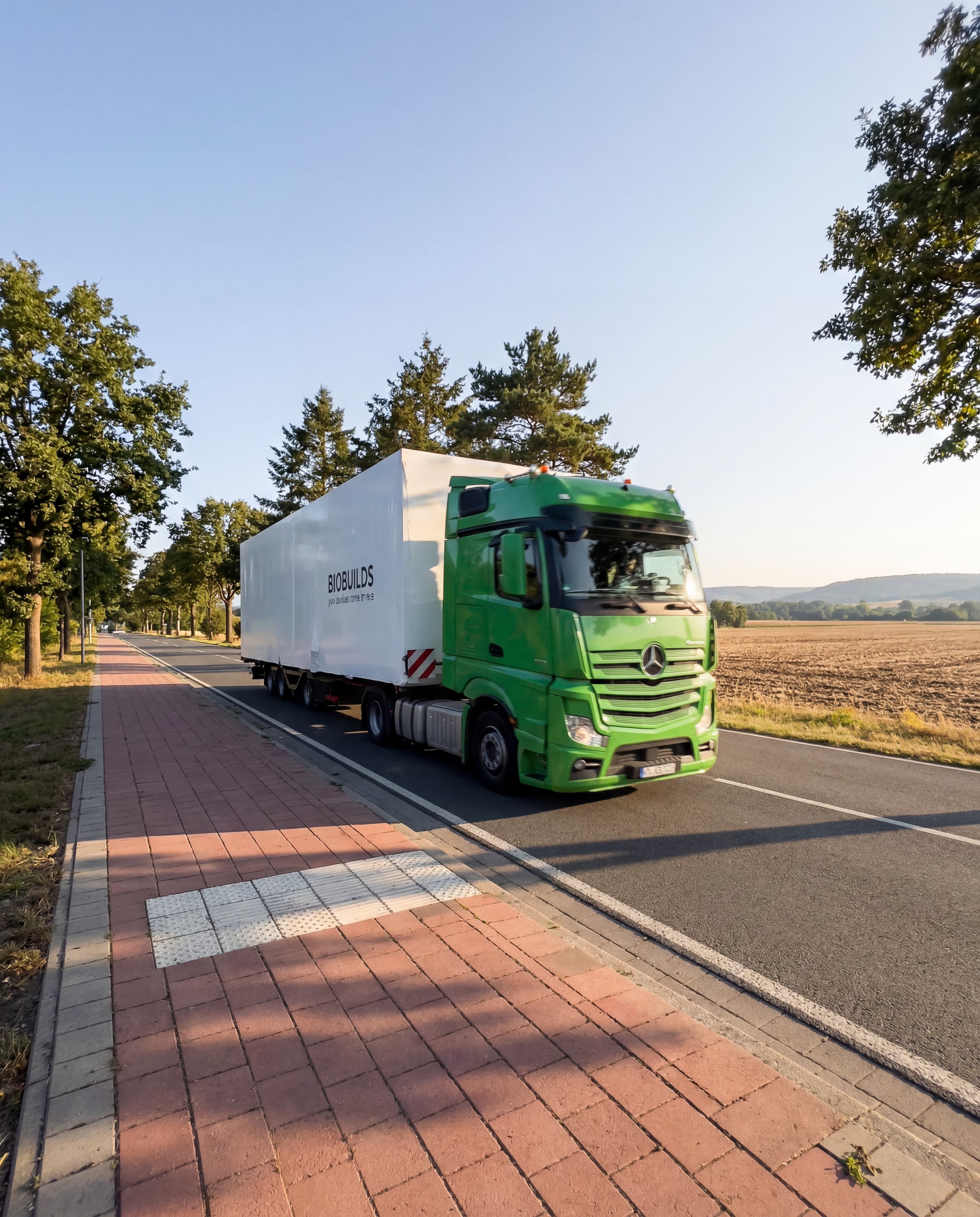
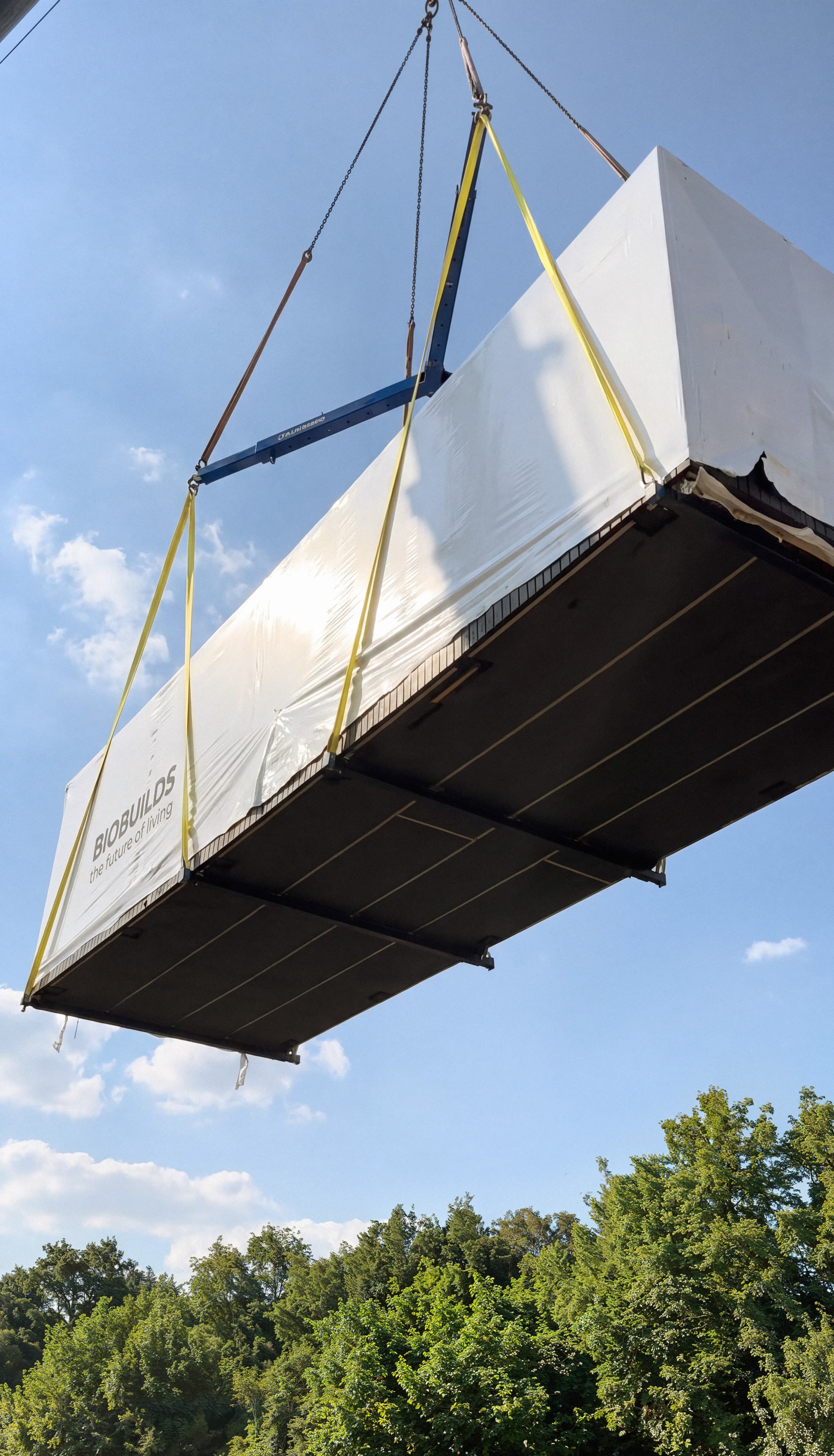
What does the transport and delivery process involve?
Logistics planning is included. Site access requirements are verified during the project planning phase.
How long does the delivery process take?
Usually a few days from factory dispatch to your site. The exact time depends on location and site conditions.
What remains for the client after delivery?
The Exterior Finished option requires interior finishing. The turnkey option is move-in ready for your furniture.
What can I customize in the configurator without affecting performance?
The configurator is designed for personalization while maintaining system performance.
Can I move window or door positions during design?
Yes, with added production-adjustment costs. Changes may slightly affect efficiency.
Can I join modules or extend later?
Yes. The system supports planned future extensions.
Can I add decks or pergolas?
Yes. Both decks and pergolas are easy to install and can be implemented independently.
What smart-home options exist?
Preconfigured lighting, blinds, and other smart systems are available. They are expandable on request.
How are changes handled after signing the order?
Changes are billed against agreed drawings. We use a transparent change control process.
What is included in the list price and what is extra?
Turnkey includes interior finishes, bathroom fittings, electrical and plumbing systems, smart systems, exterior blinds, ventilation and prepared kitchen connections. Kitchen furniture and appliances are not included. On-site assembly is included through our partners. Transport is estimated from your postcode for Germany, Austria and Romania and quoted for other destinations. Foundations, site preparation and utility hookups depend on your project and are quoted separately.
What payment types do you accept?
Financing, bank transfer, cash, company payment, crypto. Solutions are tailored to your context.
What standard warranty do you offer and what extensions are available?
24 months for consumer purchases and 12 months for commercial, per EU standard. On top of that, we provide a 5-year structural warranty. All component manufacturer warranties apply in addition.
Energy performance figures are based on Passivhaus Institut simulations under standard conditions and may vary depending on site, climate, orientation, and occupant behavior. Materials and specifications may change as part of our continuous improvement process.