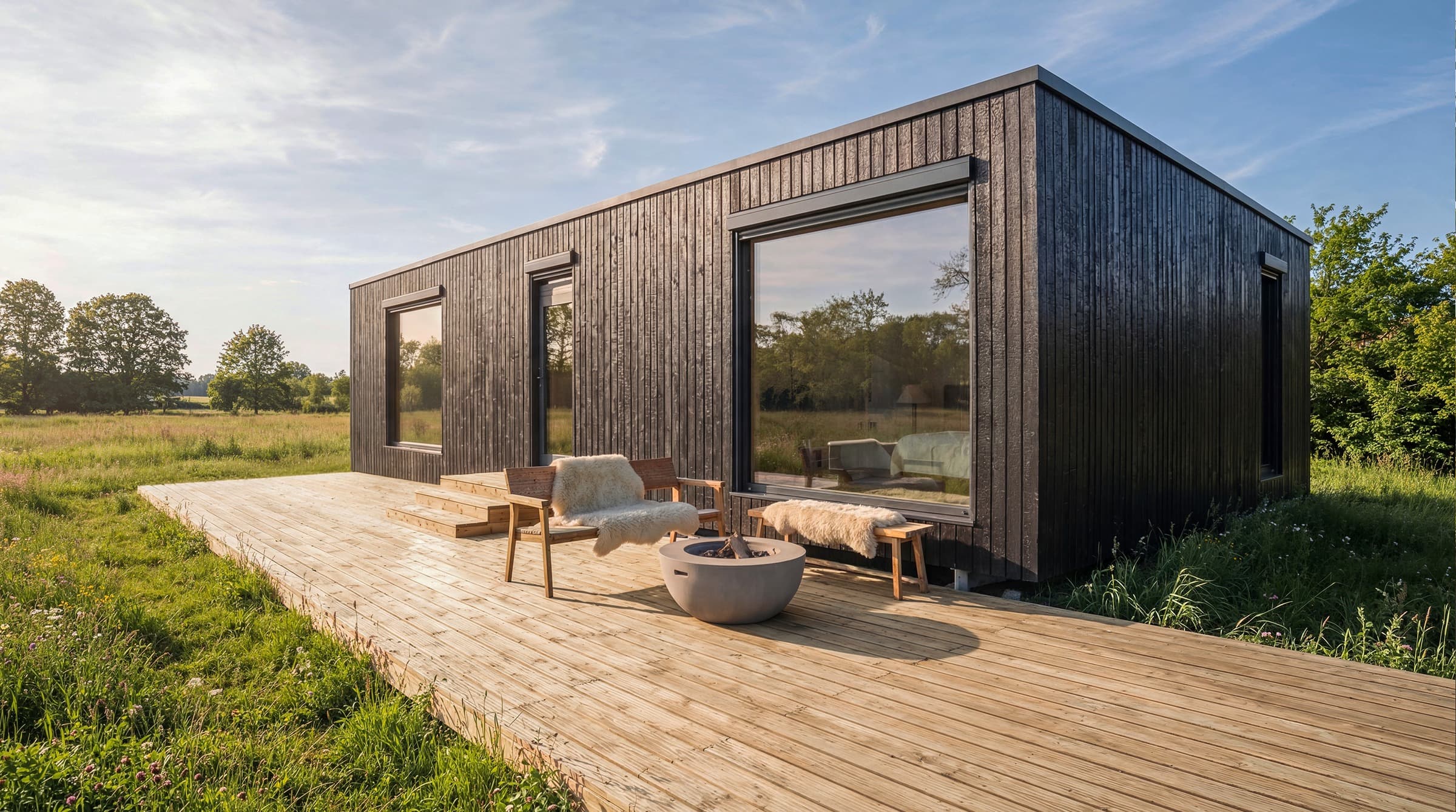
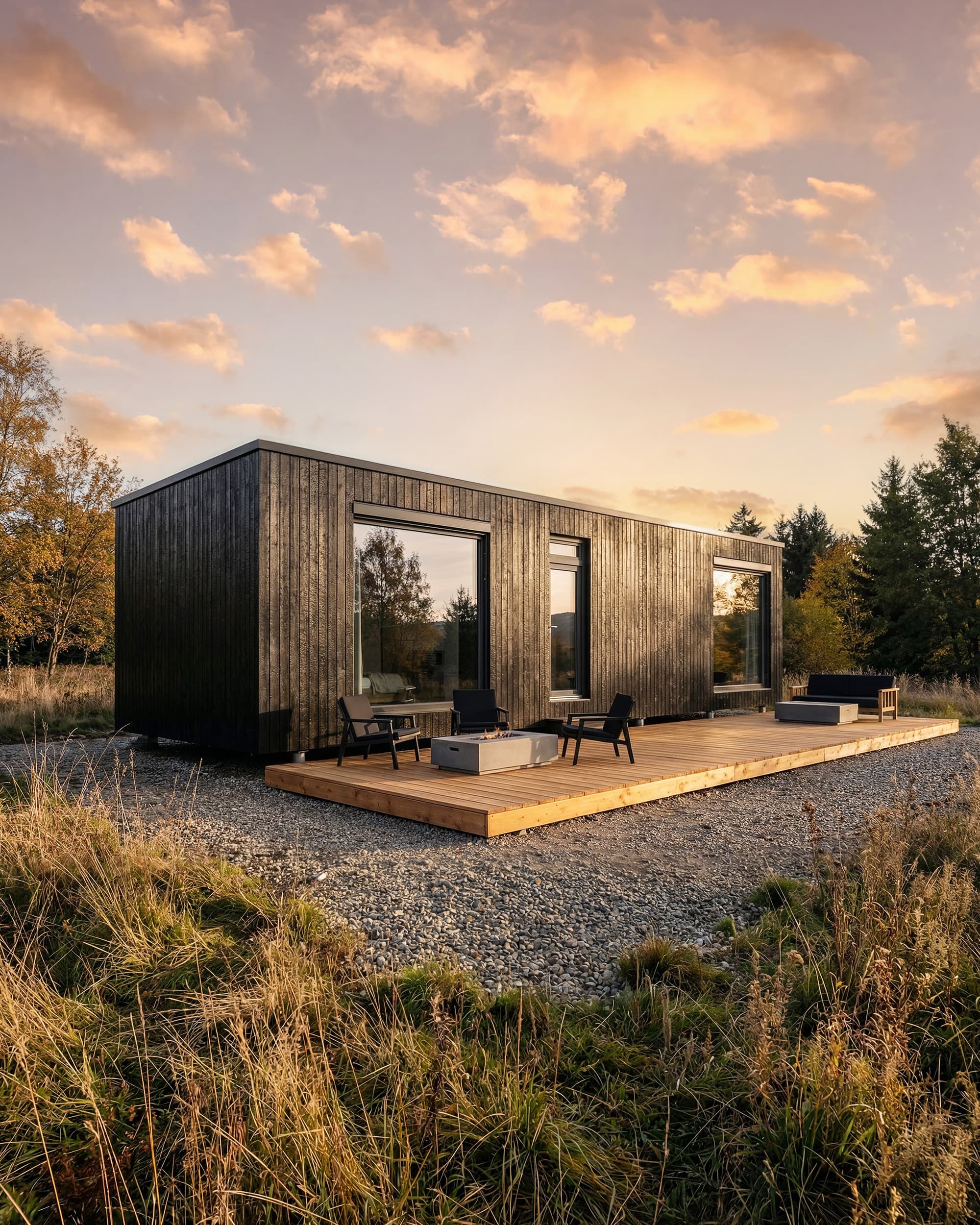

Modular construction delivers homes dramatically faster with superior quality control -- up to 80-90% faster in BioBuilds' case. Factory conditions enable tighter tolerances than site-built construction and make Passivhaus-level airtightness much more achievable. Traditional construction offers more on-site flexibility but faces far more schedule and budget volatility.
The global modular construction market reached USD 103.55 billion in 2024 and is projected to hit USD 162.42 billion by 2030 -- a 7.9% annual growth rate driven primarily by the urgent need for affordable housing. This isn't a niche trend but a fundamental shift in how buildings get built. Understanding exactly how modular stacks up against traditional construction helps you make an informed decision for your next project.
Both methods have legitimate advantages. This comparison examines the data across seven critical dimensions: timeline, cost, quality, environmental impact, design flexibility, risk, and long-term value. The numbers reveal clear patterns -- but also situations where traditional construction remains the better choice.
Quick comparison: modular vs traditional
| Factor | Traditional | Average Modular | BioBuilds Modular |
|---|---|---|---|
| Build timeline | 18-36 months | 4-7 months | 3 weeks to move-in |
| Cost per m² | Varies by market | Varies by market | €2,026–2,354/m² |
| Projects on time | <20% | ~70% | 3-week production target |
| Projects on budget | ~10% | ~80% | Fixed-price quoting focus |
| Precision tolerances | ±3-6mm+ | ±2-4mm | ±1-2mm |
| Average airtightness | Variable | Variable | Passivhaus-level target |
| Construction waste | 25-30 kg/m² | 10-15 kg/m² | 10-15 kg/m² |
| Weather dependency | High vulnerability | None (factory) | None (factory) |
| On-site flexibility | Highly adaptable | Limited once built | Limited once built |
Timeline: up to 80-90% faster build time
The timeline advantage is modular construction's most dramatic differentiator. Factory production enables parallel workflows impossible with sequential site construction -- and BioBuilds takes this further with optimized processes that deliver complete homes in weeks, not months.
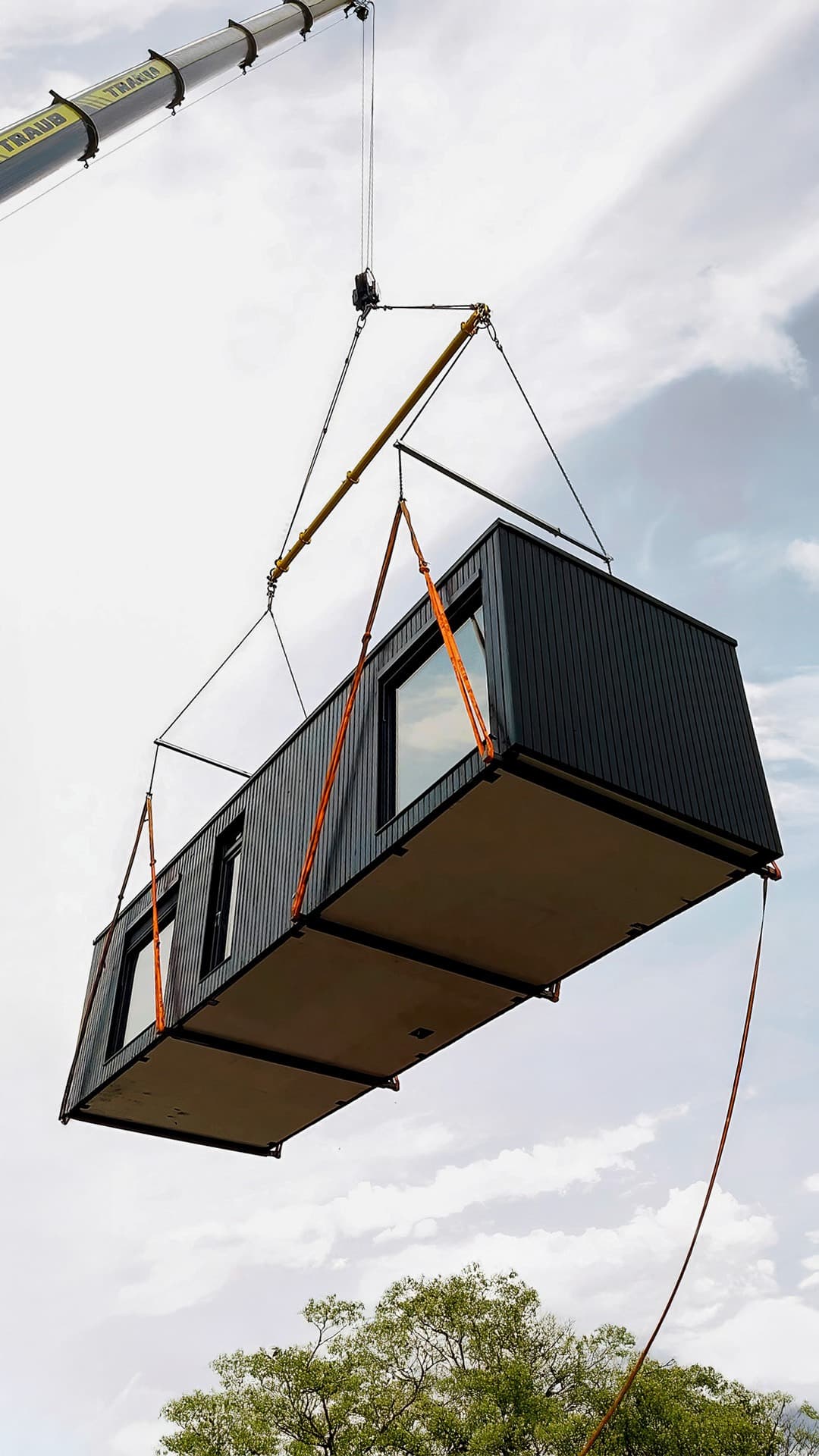
BioBuilds timeline breakdown: Factory production and site preparation happen simultaneously. Module delivery and crane setting require 1-4 days. The remaining on-site work is the final 1-2% depending on size. Total build time: 3 weeks to move-in.
Traditional timeline breakdown: Sequential dependencies mean each phase must complete before the next begins. Foundation, framing, roofing, rough-in, insulation, drywall, finishing -- each waiting on the prior. Average single-family home: 18-36 months when accounting for real-world delays, weather disruptions, and coordination issues.
Weather disruption, subcontractor coordination failures, and material delays plague traditional construction. Over 80% of all traditional projects go overtime, and 90% exceed their original budget. Factory roofs eliminate weather vulnerability entirely -- BioBuilds production proceeds identically in January blizzards or August heat waves.
BioBuilds modular wins decisively. 80-90% faster build time with predictable schedules. The 12-30 month difference saves €10,000-30,000+ in construction loan interest alone, plus eliminates months of concurrent rent payments during construction.
Cost: 15-25% lower with predictable budgets
Modular construction's cost advantages compound across multiple categories: labor efficiency, material savings, waste reduction, and timeline compression.
| Cost Category | Modular | Traditional |
|---|---|---|
| Base cost per m² | €80-160 | €150-250 |
| Labor savings | Up to 40% | Baseline |
| Material waste | 10-15 kg/m² | 25-30 kg/m² |
| Budget overruns | Fixed-price typical | 90% exceed budget |
| Financing costs | Shorter loan period | 6+ months extra interest |
The risk differential is striking. Over 80% of traditional construction projects go overtime and 90% exceed their original budget. Factory-controlled production with fixed-price contracts eliminates change orders and provides cost certainty before construction begins. A study of 1,800 projects across 106 countries found disputed costs averaged 33.6% of total project value in traditional construction.
Labor efficiency explains much of the gap. Factory assembly-line settings enable task specialization and eliminate weather-related idle time. McKinsey documents labor reductions of up to 40%. German serial construction frameworks report 22% cost reductions through standardization.
A Harvard-studied affordable housing project using modular construction beat traditional timelines by 40% and came in 4% under budget. With traditional construction, over 80% of projects go overtime and 90% exceed their original budget -- often by 20-50% or more.
Modular wins clearly. 15-25% lower base costs plus dramatically reduced overrun risk. The financial certainty of fixed-price contracts alone justifies modular consideration for budget-conscious buyers.
Quality: factory precision vs site variability
This is where perception diverges sharply from reality. Many assume site-built equals higher quality. The data shows the opposite -- site-built precision is significantly worse than factory production.
Precision machining in factory conditions achieves ±0.05-0.13mm precision for critical components. BioBuilds complete assemblies maintain ±1-2mm tolerances -- impossible to achieve on construction sites exposed to weather, varying temperatures, and variable workmanship. Traditional site-built construction typically achieves ±3-6mm at best, often worse.
This precision directly impacts energy performance. Passivhaus certification requires airtightness of ≤0.6 air changes per hour at 50 Pascals. BioBuilds positions its homes around Passivhaus-level airtightness, while site-built airtightness is far more variable because the air barrier is exposed to weather, sequencing issues, and inconsistent workmanship.
Quality control comparison
Modular: Multiple factory checkpoints -- materials inspection, framing dimensional checks, pre-close MEP verification, electrical/plumbing testing, final inspection before shipping. German QDF manufacturers receive annual external audits. ISO 9001 certification is standard.
Traditional: Typically 3-4 inspections by building officials at key milestones. Quality depends heavily on individual contractor crews and conditions. Weather exposure can compromise materials before installation.
Modern modular homes on permanent foundations are generally financed, appraised, and traded like other permanent residential properties; build quality, location, and energy performance matter more than whether the home was assembled in a factory or entirely on site.
Modular wins significantly. Factory conditions enable precision and quality control impossible on site. Weather protection, multiple checkpoints, and specialized labor produce measurably better outcomes.
Environmental impact: 50% less waste
Construction generates approximately 30% of global waste. Modular methods address this through precision manufacturing and controlled conditions.
| Environmental Factor | Modular | Traditional |
|---|---|---|
| Construction waste | 10-15 kg/m² | 25-30 kg/m² |
| Waste reduction | 80% reduced | Baseline |
| Embodied carbon | 20-45% lower | Baseline |
| Site deliveries | 90% fewer | Multiple daily |
| End-of-life reuse | Up to 95% | Demolition typical |
Factory conditions eliminate the largest waste sources: weather damage to materials, theft, over-ordering for site conditions, and cutting inefficiencies. Materials arrive at controlled delivery bays and move to workstations only when needed. Academic studies confirm roughly 80% waste reduction across projects.
Cambridge University research found 41-45% embodied carbon reduction in London modular projects. The Hong Kong "Nam Cheong 220" project achieved 95% overall reuse rate upon relocation -- impossible with traditional demolition.
Modular wins comprehensively. 50%+ waste reduction, lower embodied carbon, and genuine circular economy potential through Design for Disassembly. Traditional construction cannot match these outcomes.
Design flexibility: trade-offs exist
This is where traditional construction holds legitimate advantages -- though modular capabilities have expanded dramatically.
Where traditional excels
Complex or irregular sites: Steep slopes, narrow urban lots, or sites without crane access favor traditional methods. Modular requires flat staging areas and crane clearance.
On-site modifications: Traditional construction allows changes during the build. Modular changes after factory production become expensive or impossible.
Highly custom architecture: Unconventional forms, complex curves, or one-off artistic designs suit bespoke site construction. Modular optimizes for efficient, repeatable designs.
Where modular has caught up
Modern modular offers extensive customization within optimized parameters. BioBuilds provides four distinct models from 48m² to 190m², each with customizable floor plans, finishes, and configurations. Award-winning modular designs include HUF HAUS premium glass-and-timber homes and RIBA-awarded Ecospace Studios.
The constraint is upfront: all decisions must be finalized before factory production begins. For buyers who can commit to their design, this actually reduces stress -- no mid-build scope creep or decision fatigue.
Traditional wins for complex sites and late changes. Modular wins for buyers who value certainty and can make decisions upfront. Most standard residential projects work perfectly well with modular customization.
When to choose each method
Choose modular when:
- Timeline matters -- you need to move in quickly
- Budget certainty is priority -- you can't afford overruns
- Energy performance is important -- Passivhaus or near-zero energy
- Environmental impact concerns you
- Site has crane access and staging space
- You can finalize design decisions upfront
Choose traditional when:
- Site has severe access constraints (no crane possible)
- Highly custom architectural vision requires unusual forms
- You anticipate significant design changes during construction
- Local regulations or financing specifically require site-built
- Renovation or addition to existing traditional structure
For most residential new-build projects, modular construction delivers superior outcomes across timeline, cost, quality, and environmental impact. Traditional construction remains appropriate for constrained sites, highly custom designs, or projects requiring significant flexibility during construction.
The construction industry is shifting. With 80% of contractors reporting difficulty finding qualified workers, labor shortages will only accelerate modular adoption. The technology has matured beyond novelty -- over 23% of German residential construction now uses prefab methods. For most homebuyers, the question isn't whether modular is viable but whether the specific project conditions favor it.