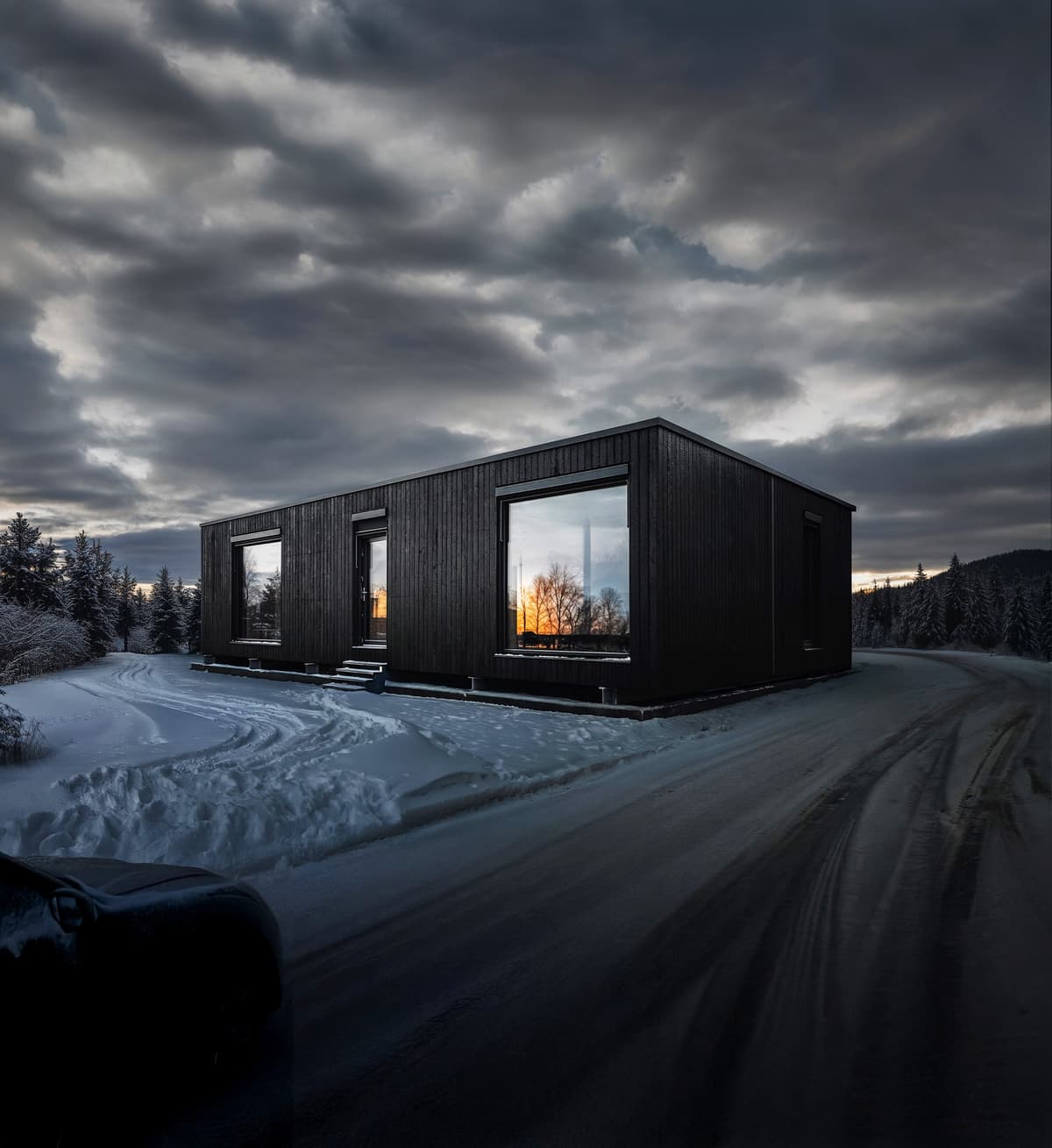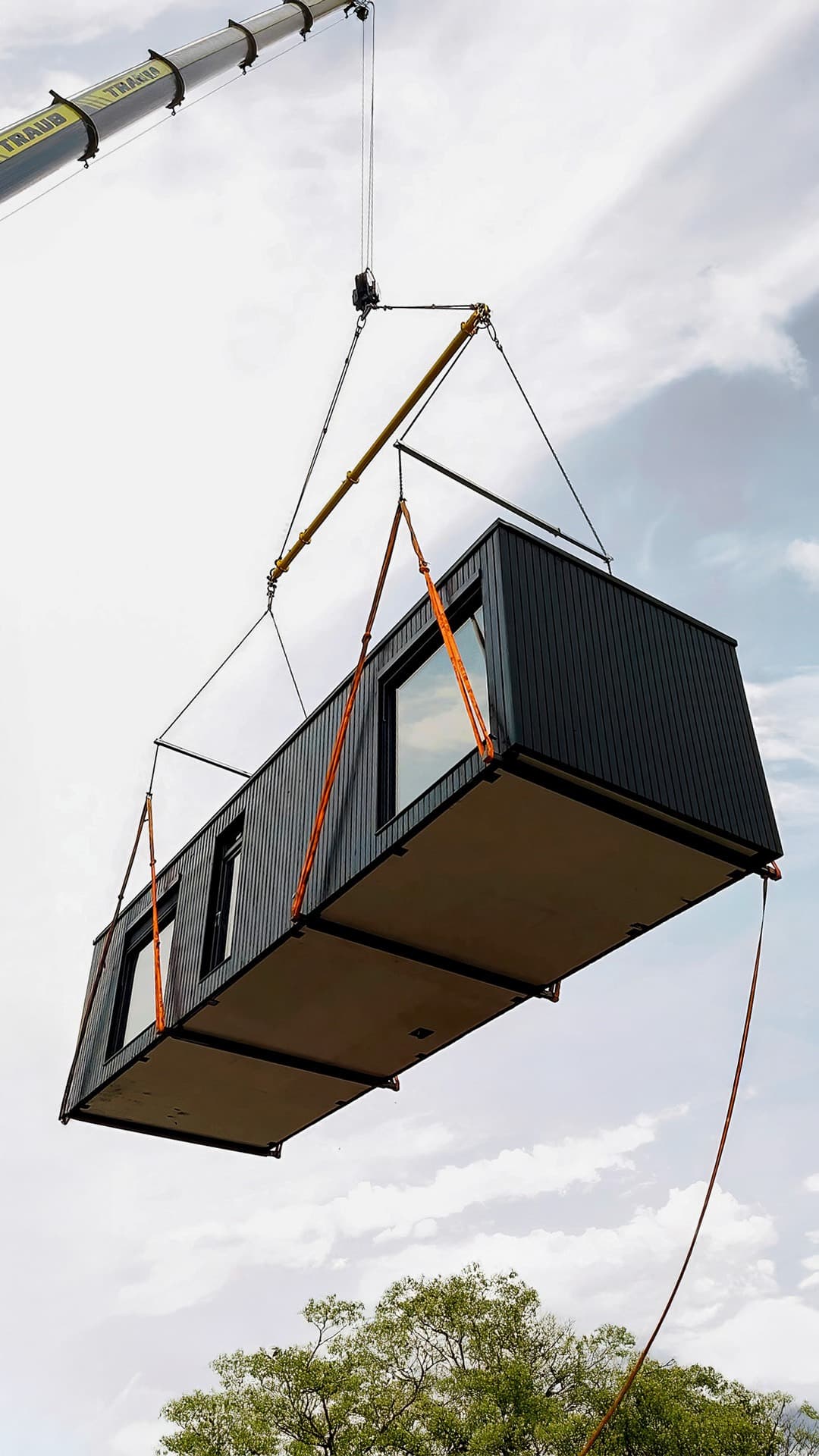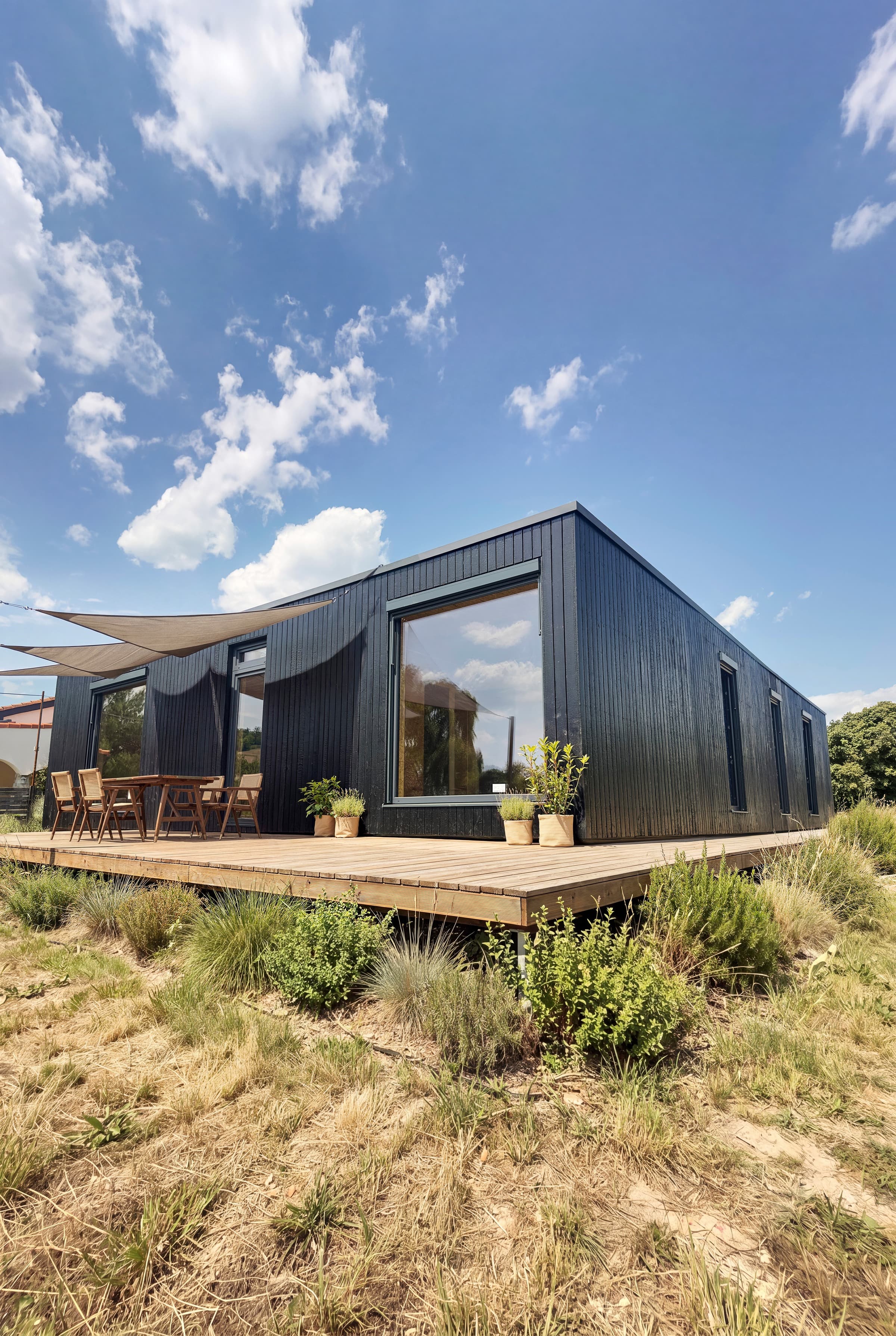
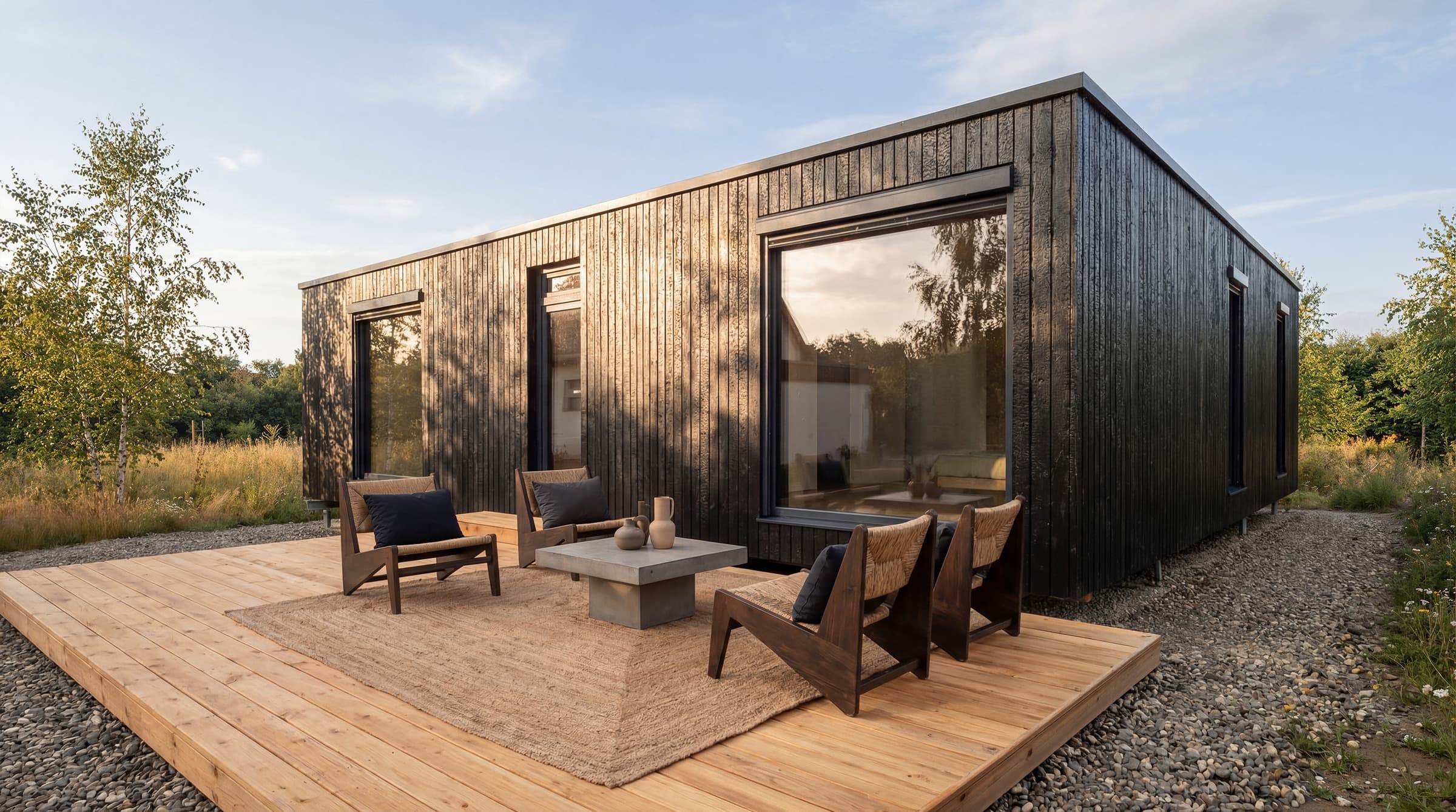
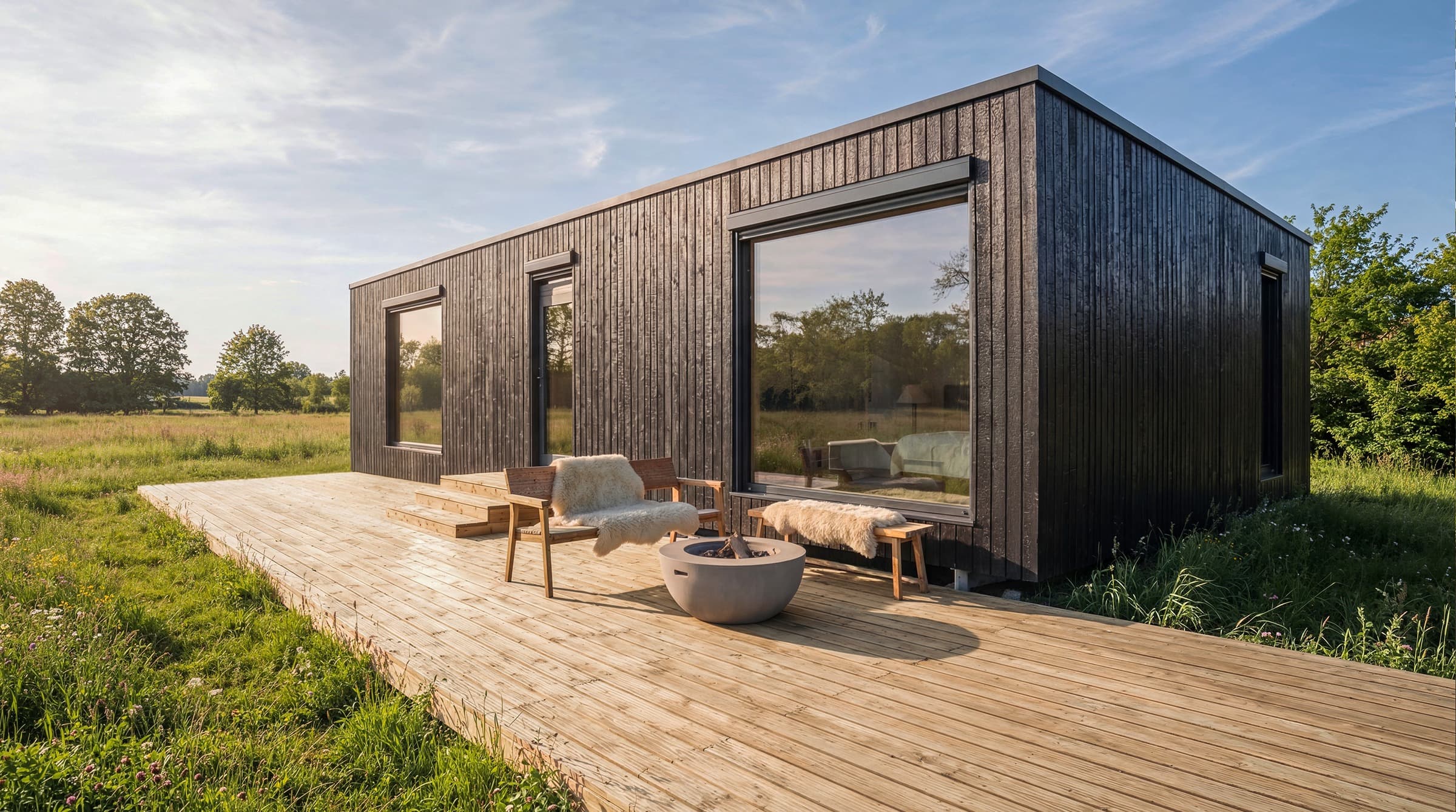
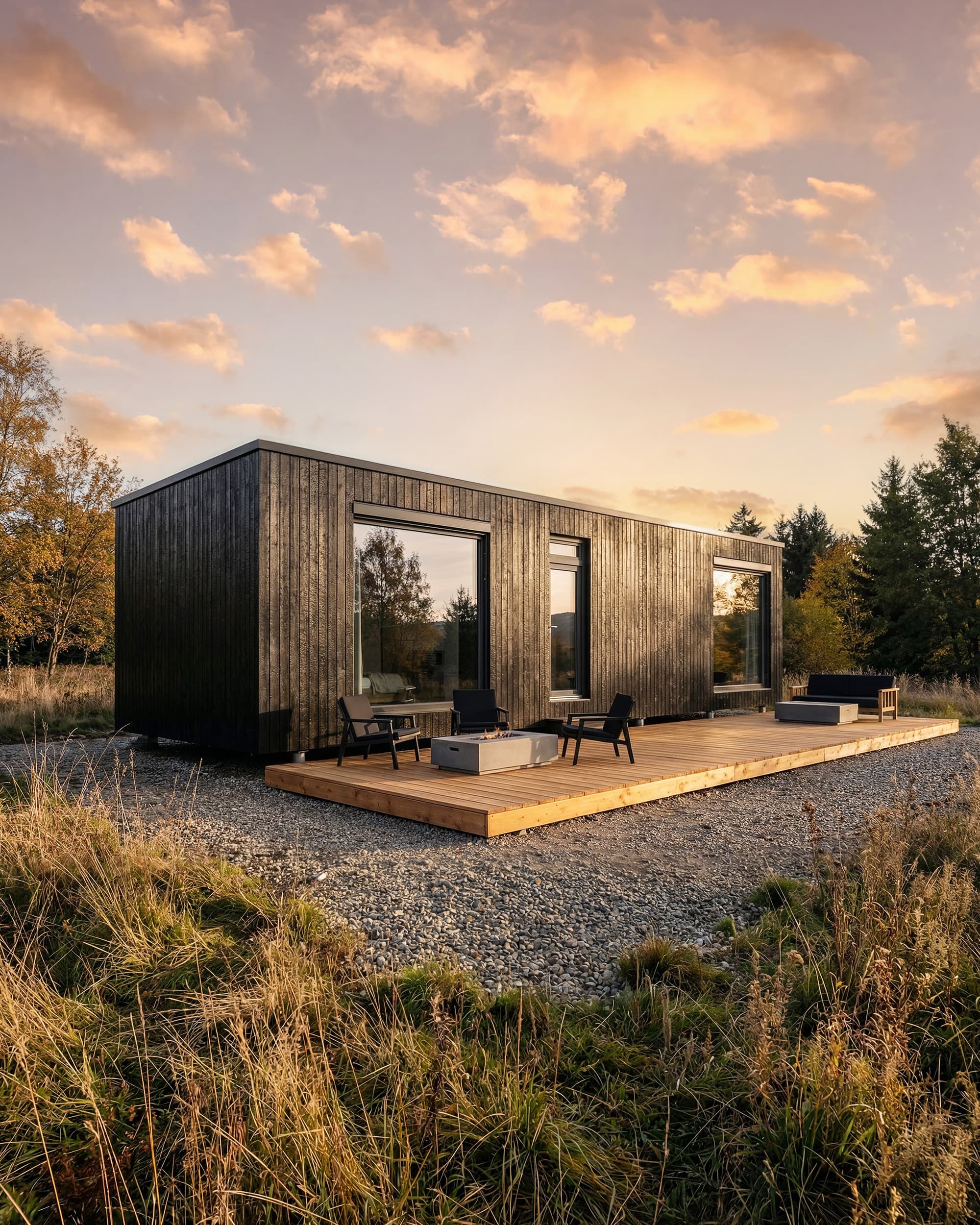
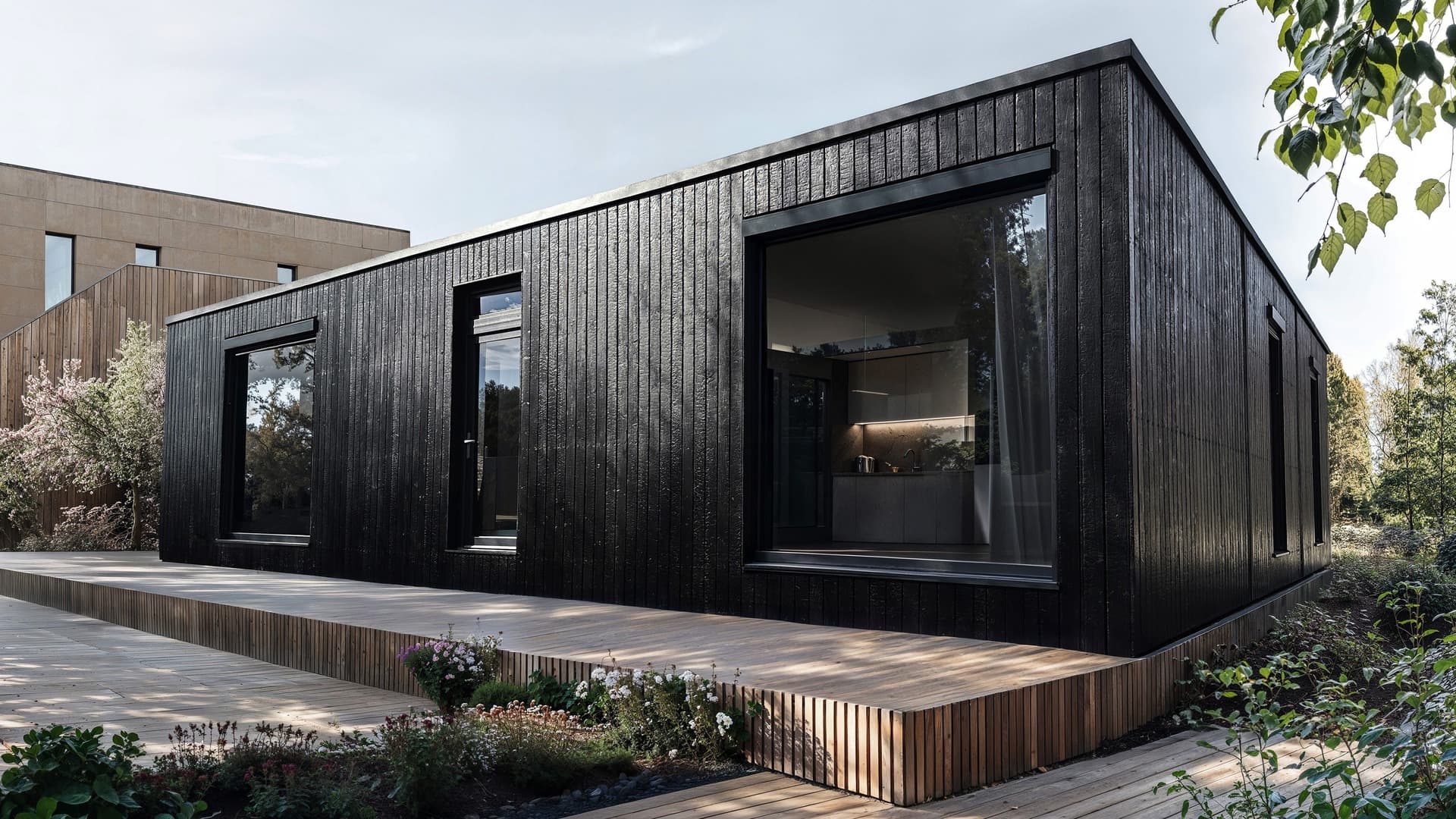
BioBuilds modular homes compress traditional 18-36 month construction into 3 weeks to move-in -- an 80-90% reduction. The controlled factory environment enables far tighter tolerances than site work, supports Passivhaus-level airtightness, and keeps almost all work indoors before delivery. Module placement on-site takes days rather than months -- your home stands complete while traditional builds haven't even finished framing.
The "3 weeks" isn't marketing hyperbole. While traditional construction exposes your future home to months of weather damage and coordination delays, factory production compresses the build into weeks of controlled, precision work. When factory-finished modules arrive at your site, crane operators have your fully-insulated, electrically-wired, plumbed home standing on its foundation in just 1-4 days. The remaining on-site work is the final 1-2% rather than the 8-12 months typical of conventional building.
Through precision manufacturing in climate-controlled facilities, German-engineered technology, and parallel workflow optimization, Passivhaus-certified modular homes reach move-in readiness in a fraction of conventional timelines -- while delivering superior airtightness, lower costs, and dramatically reduced environmental impact. This guide explains exactly how modern modular construction works and why it's transforming the European housing market.
What distinguishes modular, prefab, and manufactured homes
The terminology around factory-built housing causes persistent confusion. Understanding the distinctions matters because they affect building code classification, financing options, and long-term value.
Modular homes are complete three-dimensional volumetric units manufactured in factories at high completion levels -- up to 98% in BioBuilds' case -- including structure, mechanical systems, electrical wiring, plumbing, insulation, and interior finishes. They comply with the same regional building codes as site-built homes -- the German Landesbauordnungen, Austrian OIB Guidelines, or local Romanian standards. Permanently installed on concrete foundations, modular homes are classified as real property and appreciate identically to traditional construction.
Prefabricated (prefab) homes is the umbrella term covering all factory-built housing, including modular. In Germany, these are known as Fertighaus and now represent over 23% of new residential construction -- rising to 30%+ for single-family homes. The term encompasses both volumetric modules and panelized systems.
Panelized construction delivers flat 2D wall, floor, and roof panels to sites for assembly -- achieving only 30-50% factory completion versus the up to 98% possible with volumetric modular. While offering greater design flexibility for complex architectural forms, panelized systems require 1-3 weeks of on-site work just for weather-tight enclosure compared to modular's single-day module setting.
European modular homes must never be confused with US-style manufactured homes (built on permanent steel chassis). They share virtually nothing except partial factory production. Modular homes comply with full building codes and are permanently affixed to foundations as real property.
The factory production process
Modern modular factories operate more like automotive manufacturing plants than traditional construction sites. Computer-controlled precision, specialized workstations, and rigorous quality checkpoints transform home building from unpredictable craft into repeatable industrial process.
Design and engineering phase
BIM creates a complete digital twin before physical construction begins. Design for Manufacture and Assembly (DfMA) optimization ensures every component fits precisely. Clash detection identifies conflicts between structural, electrical, and plumbing systems before they become expensive discoveries. For Passivhaus homes, thermal bridge analysis happens at this stage -- ensuring certification success.
Factory production steps
- Frame and floor construction (Days 1-2) -- Structural components are cut with tight tolerances using lean production methods. Floors are built on precision jigs to keep assemblies accurate.
- Wall assembly (Days 2-3) -- Exterior and interior walls go up with windows pre-installed and the high-performance insulation package integrated into the envelope.
- MEP rough-in (Days 3-5) -- Electrical, plumbing, and HVAC systems installed with precise positioning for inter-module connections.
- Interior finishing (Days 5-8) -- Vapor barriers, air sealing, drywall, paint, flooring, cabinets, and fixtures complete the modules.
German factories increasingly deploy robotic arms for framing, achieving 85% production utilization rates versus approximately 65% for manual operations.
Quality control checkpoints
Factory production enables inspection intensity impossible on exposed construction sites. Materials inspection verifies certification and moisture content. Framing dimensional checks catch tolerance issues immediately. Pre-close inspections verify MEP installation before finishes conceal them. German QDF manufacturers receive annual external quality audits. ISO 9001, 14001, and 45001 certifications are standard.
Why the 3-week timeline actually works
Traditional home construction's 18-36 month duration stems largely from sequential workflows and weather vulnerability. Modular construction eliminates both constraints -- and BioBuilds takes this further with optimized factory processes that deliver complete homes in 3 weeks to move-in.
Parallel workflow optimization
While modules are manufactured in the factory, site work proceeds simultaneously. Foundation excavation, concrete pouring, and utility trenching complete during the same weeks that factory teams build your home's interior. This parallel execution compresses total project duration by 30-50%.
Weather independence
Factory roofs eliminate rain delays and temperature shutdowns. Traditional projects experienced median delays exceeding 200 days from 2020-2023 due to weather disruptions. Factory production proceeds identically regardless of conditions outside.
The module setting process
A typical two-story family home requires 4-6 hours of crane work. Experienced crews set a complete house shell in a single day. Inter-module connections require 1-2 days for structural joining, 2-3 days for roof completion.
| Construction Phase | Traditional Build | Average Modular | BioBuilds Modular |
|---|---|---|---|
| Design and permits | 3-6 months | 2-8 weeks | 2-8 weeks (same) |
| Site preparation | 2-6 weeks | 1-4 weeks (parallel) | 1-4 weeks (parallel) |
| Foundation | 3-4 weeks | 2-3 weeks (parallel) | 1-2 weeks (parallel) |
| Structure and envelope | 3-5 months | 8-10 weeks factory | 2-3 weeks factory |
| Systems rough-in | 4-8 weeks | Included in factory | Included in factory |
| Interior finishing | 2-4 months | 2-4 weeks | Included in 3 weeks |
| Total build time | 18-36 months | 4-7 months | 3 weeks to move-in |
Build time reduction: 80-90% faster. BioBuilds delivers the entire house -- from factory start to move-in ready -- in 3 weeks. This isn't achieved by cutting corners; it's the result of perfectly optimized factory processes, pre-certified building systems, and rigorous quality control at every stage. Permitting timelines remain the same regardless of construction method -- that's determined by local authorities, not the builder.
The precision advantage: millimeters matter
Factory tolerances fundamentally transform achievable quality. Precision machining in controlled conditions operates at ±0.05-0.13mm precision for critical components. Complete assemblies achieve ±1-2mm alignment -- tolerances that site construction cannot consistently match.
This precision directly enables Passivhaus certification success. Air barrier installation requires meticulous attention to every joint, penetration, and transition. When workers install membranes in controlled factory conditions -- no wind, consistent temperature, dry materials -- the execution quality differs categorically from site work.
Airtightness results tell the story
Passivhaus certification requires ≤0.6 h⁻¹ airtightness -- a standard that typical new construction (3.0-5.0+ h⁻¹) cannot approach. The differences in airtightness consistency are stark:
| Construction Method | Airtightness Result | Typical Issues |
|---|---|---|
| Traditional Site-Built | Variable | Weather damage, inconsistent workmanship, coordination failures |
| Average Modular | Variable | Speed prioritized over precision, basic QC only |
| BioBuilds Modular | Passivhaus-level airtightness | Factory precision + rigorous quality control |
BioBuilds uses the factory setting to combine speed with controlled execution. Full materials control, rigorous quality checkpoints at every stage, and optimized processes mean the advantages of modular construction -- speed, weather protection, precision -- are fully realized rather than partially exploited.
Cost reality: where modular savings come from
European modular homes offer 15-25% cost advantages over traditional construction when properly optimized. The savings compound across multiple categories.
| Market | Modular (EUR/m²) | Traditional (EUR/m²) | Savings |
|---|---|---|---|
| Germany | €1,350-2,500 | €2,200-3,000+ | 15-25% |
| EU average | €1,500-2,500 | €1,800-2,800 | 10-20% |
| Romania | €1,200-2,500 | €1,500-2,500 | 10-15% |
| BioBuilds Passivhaus | €2,026–2,354/m² | - | Based on current public model pricing |
Labor efficiency drives savings
McKinsey research documents labor reductions of up to 40% in modular construction. German serial construction frameworks report 22% cost reductions through standardization.
Material waste reduction
Traditional construction generates 25-30 kg waste per m²; modular reduces this to 10-15 kg/m². Studies confirm roughly 80% waste reduction across projects.
Financial benefits from compressed timelines
Shorter construction reduces financing costs. A project finishing 6 months early saves proportionally in carrying costs. Fixed-price contracts eliminate the 28% average cost overruns typical of traditional construction.
Environmental performance beyond construction
Modular construction's sustainability advantages extend across the building lifecycle, from production through potential future reuse.
Carbon footprint during construction
Research documents embodied carbon reductions of 20-45% compared to traditional methods. Cambridge University found 41-45% reduction in London modular projects. Timber-frame construction stores carbon within the structure -- 2 tonnes CO2 reduction per tonne of steel substituted.
Circular economy potential
Modular bolt-and-nut connections enable future disassembly rather than demolition. The Hong Kong "Nam Cheong 220" project achieved 95% overall reuse rate upon relocation. Design for Disassembly can reduce global warming potential by 63% over building lifecycles.
BioBuilds presents 98% organic materials and ground-screw compatibility as part of the modular system's flexibility -- minimal site disturbance, less cement dependency, and the option to adapt the home as needs change.
The European market context
Germany leads in scale
The German prefab market reached USD 7.64 billion in 2025, projecting to USD 10.23 billion by 2030. Timber dominates with 61% market share. Over 23% of German residential construction uses prefab methods (30%+ for single-family homes). Berlin mandates 30% prefab allocation for new municipal housing.
Austria excels in timber innovation
Austria leads European mass timber construction innovation. The CO2 Bonus program offers €1 per kilogram of wood used, covering up to 50% of costs. Austria supplies 20.4% of Germany's prefab wooden house imports.
Romania offers manufacturing advantages
Romania's modular market achieved 14.3% annual growth from 2020-2023, reaching €480 million. The country offers labor cost advantages with full EU compliance. Romania holds 10.65% of construction employment -- the highest in the EU.
Transportation and site logistics
European module dimension limits
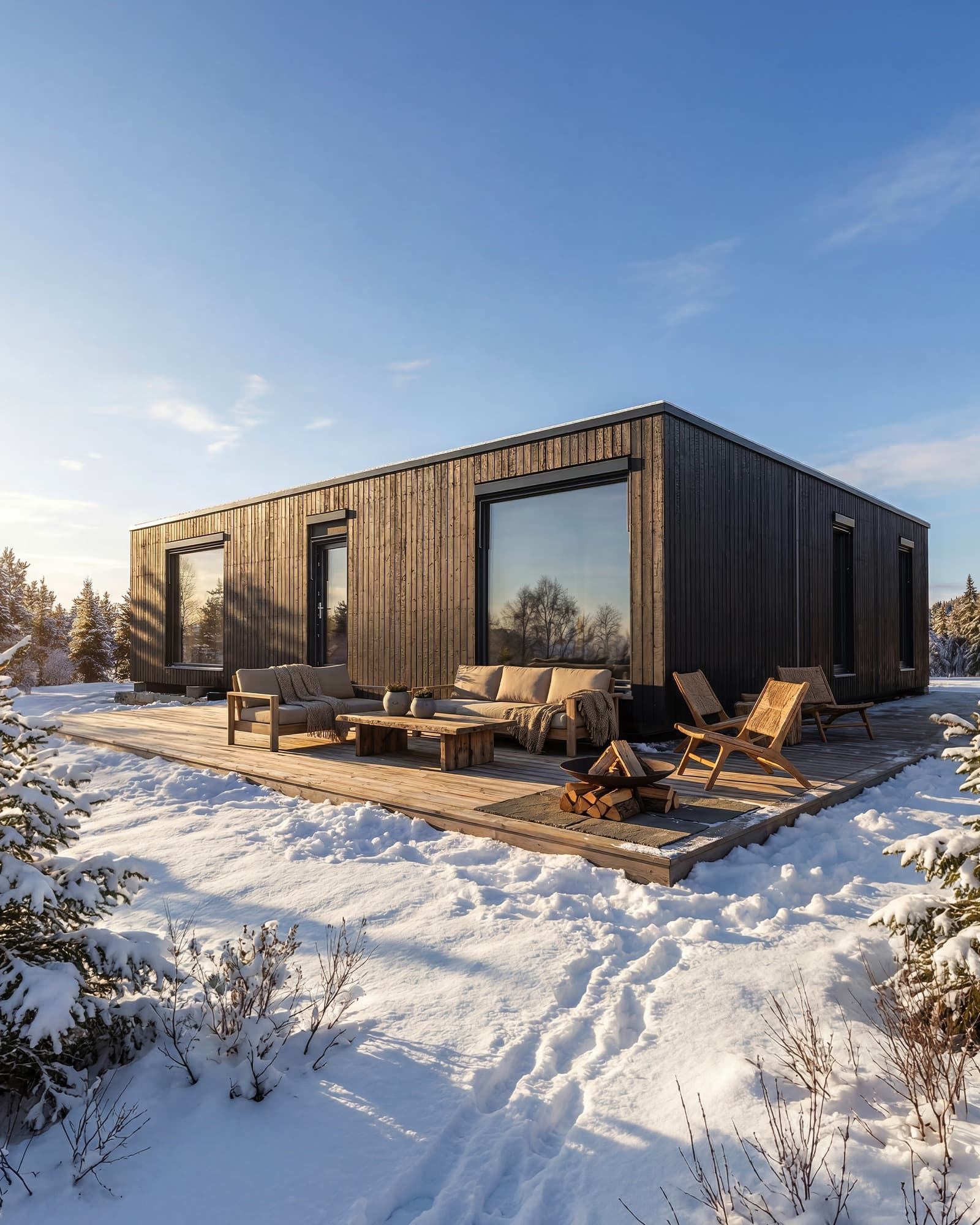
Standard modules measure approximately 5.3m wide x 14.5m long x 3.8m high -- exceeding EU road limits. Special Transport Permits are required for every delivery. Escort vehicles are mandatory above 3.5m width, with police escorts for the largest loads. Transport is restricted to 06:00-22:00 on weekdays.
Crane requirements and site preparation
Standard modules require 100-ton crane capacity. Site staging needs minimum 8 x 8 meters of level ground. Power line clearance of 15 feet minimum is mandatory. Crane services cost €3,000-10,000.
Foundation options
Modular homes can be paired with different foundation strategies depending on the project. BioBuilds presents both ground screws and traditional concrete slabs as viable options, with the exact setup depending on site conditions, local engineering, and utility coordination.
Addressing persistent misconceptions
"Modular homes are temporary structures"
Fact: Modular homes are engineered for 80+ year lifespans -- identical to traditional construction in legal classification and building-code treatment. They are classified as real property and subject to the same building codes.
"Modular homes all look the same"
Fact: Modern modular enables complete architectural customization. Award-winning examples include Ecospace Studios (RIBA Award winner) and HUF HAUS's premium designs. BioBuilds offers four distinct models from 48m² to 190m², each fully customizable.
"Resale value is lower"
Fact: Urban Institute research confirms modular housing appreciates at essentially the same rate as site-built homes. Energy efficiency features can command premium valuations.
"Financing isn't available"
Fact: Modular homes qualify for all standard mortgage products. Germany's KfW offers favorable loans for efficient homes. Austria provides CO2 Bonus subsidies. Standard insurance covers modular homes like any permanent structure.
The European housing shortage, construction labor scarcity (44% of EU shortfalls are in construction), and sustainability requirements all favor factory production. Whether your priority is faster occupancy, better energy performance, cost predictability, or environmental responsibility, modular construction delivers advantages that site-built methods structurally cannot match.
The precision achievable in factory conditions -- ±1-2mm versus site construction's ±3-6mm -- directly enables the airtightness and thermal performance that define truly comfortable, efficient homes. When your walls arrive factory-sealed rather than assembled in rain, when your timeline is measured in weeks rather than seasons -- that's when modular delivers its full potential.