A Passive House uses up to 95% less heating energy than conventional buildings through five core principles: super-insulation, triple-glazed windows, mechanical ventilation with heat recovery, airtight construction, and thermal bridge-free design. The key benchmark is performance, not utility-bill promises: around 15 kWh/m²/year for heating versus roughly 150 kWh/m²/year for a new conventional home. With German KfW grants up to €37,500 and EU subsidies available across multiple countries, the premium often narrows substantially.
The Passive House standard delivers what conventional construction promises but rarely achieves: a building that maintains comfortable temperatures year-round while consuming almost no heating energy. Developed by the Passive House Institute in Darmstadt, Germany, this voluntary certification has grown from a single prototype in 1991 to over 47,400 certified units worldwide. The appeal is simple: heating demand drops toward the 15 kWh/m²/year benchmark, and the building performs this way for decades without degradation.
For homeowners in Germany and Romania, understanding Passive House construction has become increasingly practical rather than aspirational. Construction premiums have fallen to 5-10% in mature markets, government subsidies can eliminate the additional cost entirely, and upcoming EU regulations will mandate similar performance standards for all new buildings by 2030. This guide covers every aspect of the decision: what the standard requires, what it costs, what you save, and how to get there.
What is a Passive House
A Passive House is a building designed to maintain thermal comfort through passive means -- high insulation, airtight construction, and heat recovery -- rather than through active heating and cooling systems. The name comes from this fundamental shift: rather than actively pumping energy into the building to maintain comfort, the building passively retains the heat generated by occupants, appliances, and sunlight.
The practical result is striking. A certified Passive House requires so little heating that thermal comfort can be maintained solely through post-heating or post-cooling the fresh air required for ventilation. Traditional radiators and heating systems become optional rather than essential. The building functions less like a structure that constantly fights against the outside environment and more like a thermos that simply maintains its internal temperature.
The Passive House standard proves that comfort and efficiency are not competing objectives. Buildings that use 90% less energy for heating consistently achieve higher occupant satisfaction scores than conventional construction.
-- Dr. Wolfgang Feist, Passive House Institute
This differs fundamentally from other green building certifications. Standards like LEED or BREEAM award points across multiple categories -- water efficiency, materials, location. A building might score well overall while performing poorly in any single area. Passive House focuses exclusively on energy performance and indoor climate, requiring buildings to pass or fail based on measured outcomes. There is no point system, no category trading. Either the building meets the criteria or it doesn't.
The five certification criteria
Every Passive House must satisfy five measurable requirements. The CEPHEUS study, monitoring 221 dwelling units across five European countries, verified that buildings meeting these criteria achieve heating consumption averaging just 13.4 kWh/m² per year versus 65.6 kWh/m² for low-energy alternatives -- an 80% reduction validated through years of real-world measurement.
Space heating demand
The signature requirement limits annual heating to 15 kWh/m² or a peak heat load of 10 W/m². For context, the average German building stock consumes 112 kWh/m² annually, while typical Romanian residential buildings consume 180-250 kWh/m². This single criterion represents a 7-15x improvement over existing housing. The BioBuilds system combines insulation with U-values around 0.14 W/m²K, triple glazing with Ug = 0.50 W/m²K, Genesis 90 frames with Uf = 0.76–0.78 W/m²K, and thermal bridge-free junctions.
Primary energy demand
Total energy consumption -- including heating, cooling, hot water, and all electrical systems -- must stay below specific limits. The Classic tier permits 60 kWh/m² of Primary Energy Renewable (PER) annually, while Plus requires 45 kWh/m² or less (with at least 60 kWh/m² of on-site renewable generation), and Premium requires 30 kWh/m² or less (with 120 kWh/m² renewable generation). This ensures that heating efficiency gains aren't offset by excessive consumption elsewhere.
Airtightness
Air leakage must not exceed 0.6 air changes per hour at 50 Pascals pressure differential, verified through mandatory blower door testing. Standard homes measure approximately 5-15 ACH@50Pa, making them 10-25 times leakier. This requirement proves most challenging for site-built construction -- every penetration, junction, and service entry must be meticulously sealed. Factory-built construction achieves this more consistently, which is one reason BioBuilds repeatedly frames modular production as an advantage for Passivhaus performance.
Thermal comfort
Interior temperatures must remain within strict bounds: surface temperatures above 17°C in winter to prevent condensation and discomfort, and room temperatures not exceeding 25°C for more than 10% of occupied hours annually. Temperature differences between floor and ceiling must stay below 2°C. These limits prevent designs that achieve heating efficiency at the expense of summer overheating or cold radiating surfaces.
Thermal bridge-free construction
All junctions in the building envelope must achieve linear thermal transmittance of 0.01 W/(mK) or less. Thermal bridges -- points where heat bypasses insulation at corners, window frames, or structural connections -- can account for 24-40% of total building heat loss when unaddressed. Eliminating them requires careful detailing at every junction, a task easier to accomplish in controlled factory conditions than on construction sites.
The five criteria function as an integrated system. The heating demand target is impossible without superior airtightness, which requires thermal bridge-free construction. Certification validates that all elements perform together as designed -- there are no shortcuts or category trades.
Costs across Germany and Romania
Market maturity dramatically affects both base construction costs and the premium for Passive House performance. The EU leads Europe with over 14,000 certified buildings and premiums as low as 5-10%, while Romania's emerging market faces 10-20% premiums and significant component import requirements.
| Market | Conventional €/m² | Passive House €/m² | BioBuilds Passivhaus €/m² |
|---|---|---|---|
| Germany | €2,500-3,000 | €2,700-3,500 | €2,200 |
| EU average | €2,200-2,800 | €2,800-3,500 | €2,200 |
| Romania | ~€1,800 | ~€2,500 | €2,200 |
In Germany, component costs have declined substantially as triple glazing achieved over 70% market penetration. The Passive House Institute's analysis shows total additional investment for a 140m² house dropped from €14,000 to €9,500 between 2009-2015, with window upgrade costs alone falling from €5,400 to €1,600. Today, MVHR systems cost around €6,000 including installation, while PHI building certification fees run approximately €8,000 for straightforward residential projects.
EU average shows significant regional variation -- construction in Salzburg, Tyrol, and Vorarlberg runs up to 50% higher than eastern regions like Niederösterreich and Burgenland. Vienna construction averages €2,600-2,800/m². The most experienced EU designers have achieved cost-neutral Passive House builds compared to standard construction, demonstrating that premiums primarily reflect market maturity rather than inherent technical requirements.
Romania faces structural challenges: most PHI-certified components must be imported from Germany or Austria, the country has only 3 certified PHI building certifiers nationwide, and the skilled Passive House workforce remains limited. A documented example shows a 140m² passive house at €126,000 versus €91,000 conventional -- a 38% premium reflecting limited local supply chains rather than inherent costs.
Subsidies and incentive programs
Many subsidies are available for Passivhaus construction, since it is the strictest energy efficiency standard in the world. Germany, the EU, and several other countries offer programs that can significantly offset or even eliminate the construction premium. But the biggest savings come from the efficiency itself -- reduced energy bills year after year, regardless of how energy prices fluctuate.
Real savings and payback periods
BioBuilds positions its homes as using up to 95% less energy for heating and cooling than conventional construction. That level of reduction translates into substantial annual cost savings where local energy prices and climate make the comparison meaningful.
For a typical 95m² home, the exact annual savings depend on local energy prices, climate conditions, and occupant behavior. BioBuilds' own calculator methodology compares Passivhaus-level performance against regional conventional building consumption to illustrate the scale of the savings rather than promising a single universal number.
Resale value premiums of 8-18% are documented for high-efficiency buildings across European and Australian markets. Knight Frank research shows properties with high energy ratings command significant premiums versus equivalent standard buildings. The combination of lower operating costs, superior comfort, and future-proofing against tightening regulations makes Passive House properties increasingly attractive to buyers.
The certification process
Passive House certification proceeds through distinct phases over 12-24 months for residential projects, from initial concept through final certificate issuance by the Passive House Institute or an accredited certifier.
Pre-design phase (1-2 months)
Site evaluation, team assembly, and decision on certification tier (Classic, Plus, or Premium). A Certified Passive House Designer/Consultant -- over 5,000 certified worldwide, searchable at passivhausplaner.eu -- typically leads energy calculations. The database at passivehouse-database.org lists nearly 6,000 certified projects for reference.
Design development (4-6 months)
Complete PHPP (Passive House Planning Package) verification. PHPP is an Excel-based tool costing €200-350 that achieves accuracy of ±0.5 kWh against measured building performance. The related designPH SketchUp plugin (€200-400) provides 3D geometry input and shading analysis. During this phase, the certifier reviews all energy-relevant planning documents, construction product data, and identifies necessary corrections.
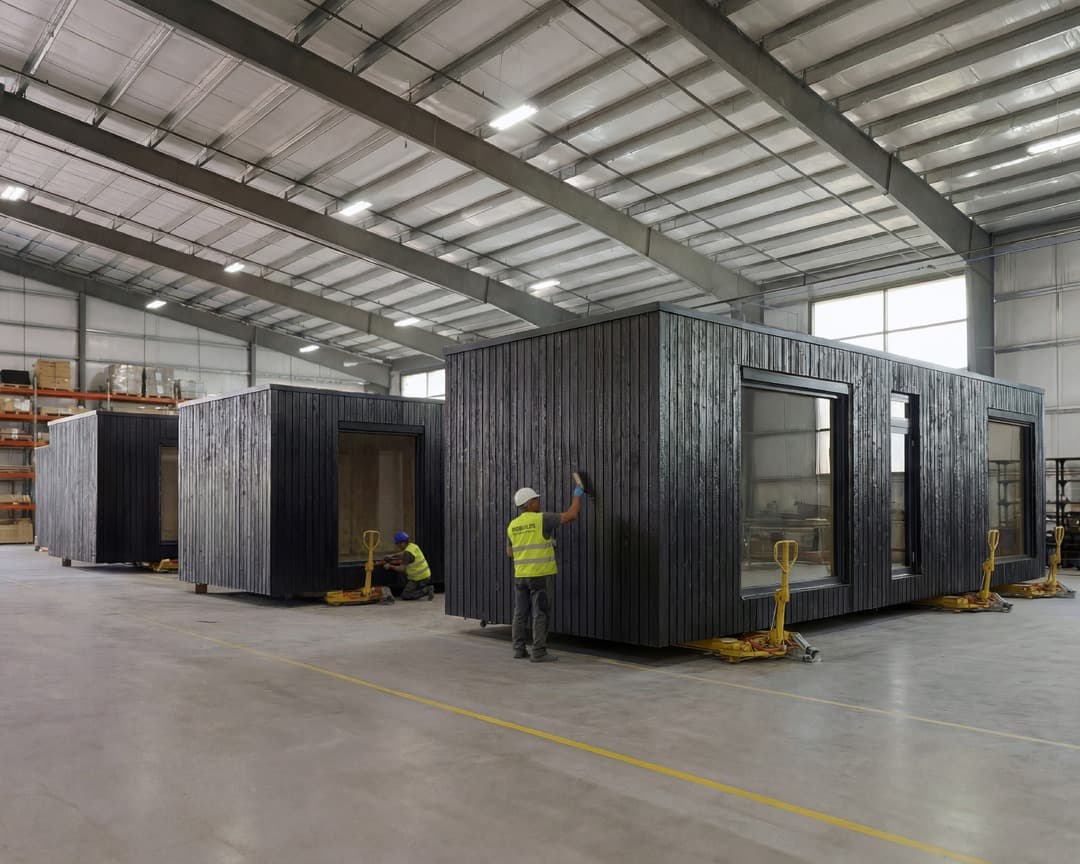
Construction (6-12 months for site-built; 3 weeks + 2-3 days for modular)
Critical quality control checkpoints throughout. A construction-phase airtightness test when the airtight layer is accessible allows leak detection and repair before finishes. The building certifier must remain independent from the design team. Factory-built modular construction can compress this phase dramatically because more of the envelope and service coordination is completed indoors before delivery.
Final certification (2-6 weeks)
Requires updated PHPP with any construction changes, signed blower door test report (EN 13829 Method A), ventilation flow rate adjustment protocol, construction manager's declaration, and photo documentation of all energy-relevant details.
Typical certification-related costs for residential projects:
- Building certification fee: €1,500-3,500
- PHPP software: €200-350
- PHPP consultant services: €3,000-15,000
- Blower door test: €300-800
- Thermal bridge calculations: €500-2,000
- Ventilation commissioning: €500-2,000
- Total: €5,000-15,000
For EnerPHit retrofits of existing buildings, heating demand limits relax to 20-25 kWh/m²/year (climate-dependent) and airtightness to 1.0 ACH@50Pa, acknowledging practical constraints. Component method certification alternatively requires individual components to meet specific U-value criteria rather than overall energy performance.
Passivhaus Component Certification (Construction Systems)
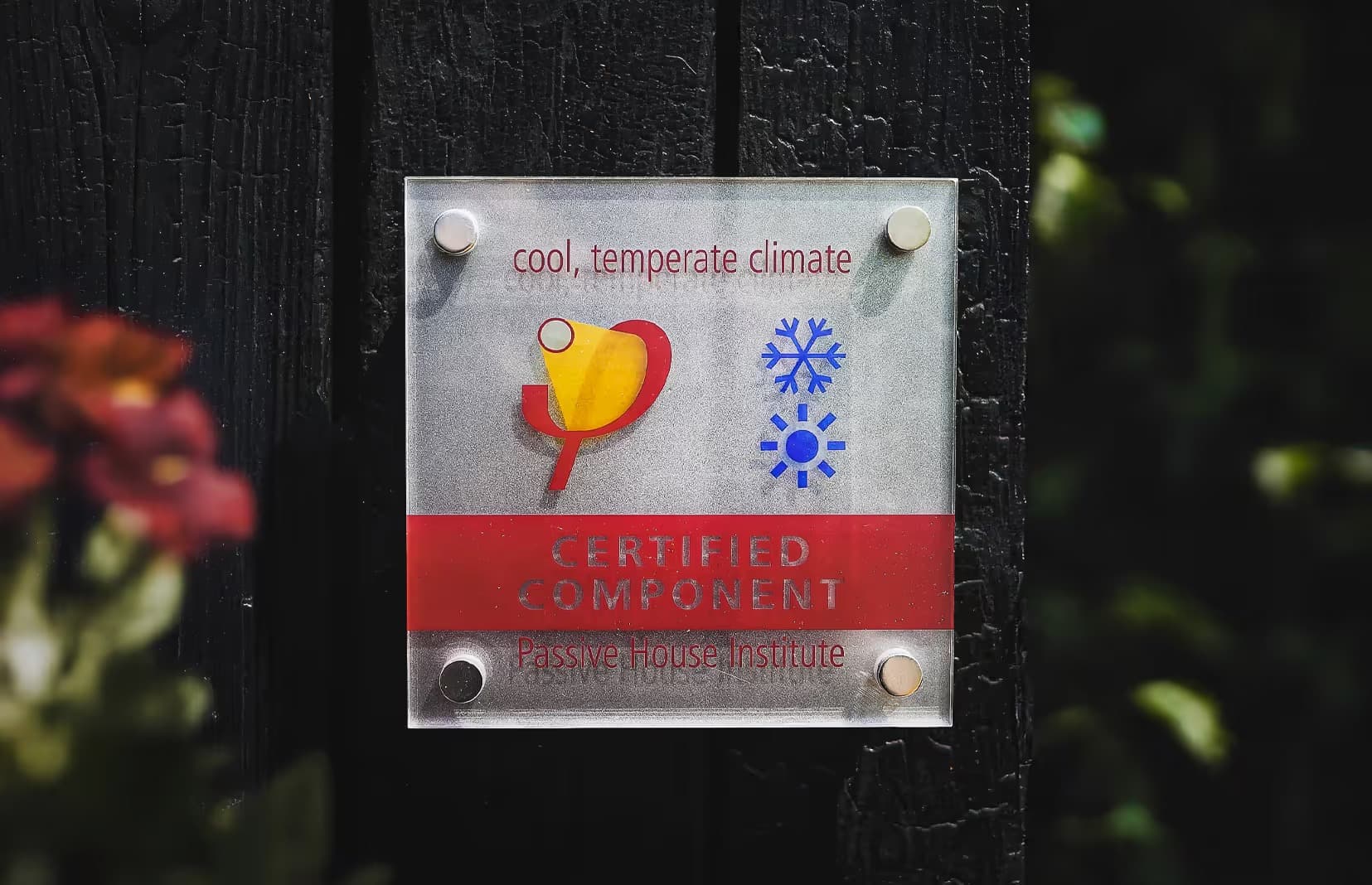
Beyond individual building certification, the Passive House Institute offers Component Certification for entire construction systems. This allows manufacturers to pre-certify their complete building system -- including wall assemblies, roof systems, floor systems, and connection details -- at the factory level rather than certifying each individual project separately.
Across the site, BioBuilds presents its modular system as Passivhaus-aligned and describes technical components and assemblies in detail. Some technical copy also refers to the prefabricated system as being in the certification process for official component certification. The practical takeaway for buyers is that the envelope and assemblies are being positioned around Passivhaus performance targets. The advantages are significant:
- Guaranteed performance: The thermal envelope, airtightness details, and thermal bridge-free connections are validated at the system level
- Faster project certification: Individual homes require less documentation since the construction system is already certified
- Consistent quality: Factory-controlled production ensures every unit meets the certified specifications
- Reduced certification costs: Project-level certification fees decrease when using a pre-certified construction system
This system-level certification represents the highest level of quality assurance in Passivhaus construction, ensuring that performance is built into the manufacturing process rather than verified only after construction.
Health and comfort benefits
Beyond energy savings, Passive Houses deliver measurably better indoor environments. The mechanical ventilation with heat recovery (MVHR) that enables the energy performance simultaneously provides constant filtered fresh air, stable temperatures, and controlled humidity.
A comprehensive review of 648 dwellings across 35 studies found that 74% of Passive House dwellings never measured CO2 above 1,400 ppm, compared to significantly higher exceedances in naturally ventilated homes. Chinese research measured CO2 levels of 622-841 ppm in passive houses versus over 1,000 ppm in conventional flats.
Air quality improvements
A Swedish study of 20 passive versus 21 conventional new houses found NO2 levels 17% lower in passive houses (10 vs 12 ug/m³), formaldehyde 31% lower (11 vs 16 ug/m³), and ozone 12% lower (9.7 vs 11 ug/m³). UK research documented PM2.5 particulate levels inside a Passive House at approximately half those of a conventional house on the same street -- the required F7 filters effectively reduce outdoor pollution infiltration.
Temperature stability
Temperature fluctuation in passive houses typically stays within ±1-2°C versus ±4-6°C in conventional buildings. Polish monitoring over 2018-2022 maintained indoor temperature at 22°C average while outdoor temperatures ranged from -28.2°C to 36.2°C. Interior surface temperature differentials max 1°C below room temperature versus 3-5°C below in conventional construction -- eliminating cold spots near windows and walls.
Humidity control
Passive Houses achieve the optimal 30-60% relative humidity range consistently, mitigating both pathogen spread (high humidity) and virus transmission plus skin problems (low humidity). UK studies showed 75% of MVHR-equipped homes met target humidity levels below 7 g/kg absolute humidity, with bathroom moisture clearing within 3 hours.
Acoustic performance
Triple glazing achieves 35-44 dB noise reduction versus 25-30 dB for standard double glazing -- specialized acoustic triple glazing can reach up to 54 dB reduction. Super-insulated wall assemblies typically provide 45-55 dB reduction, outperforming standard construction by 10-15 dB. Occupants consistently report significantly quieter interiors, particularly valuable in urban locations or near traffic.
CEPHEUS and subsequent studies show occupants rate health status slightly higher in mechanically ventilated homes, with health improving significantly more frequently than control groups. Common complaints center on winter dryness in bedrooms (manageable with humidity control) and MVHR noise when poorly installed (avoidable with proper commissioning).
EU regulations and the future
The revised Energy Performance of Buildings Directive (EPBD 2024/1275) entered force May 28, 2024, with Member State transposition deadline of May 29, 2026. Its requirements will fundamentally reshape European construction -- and make Passive House performance the de facto standard rather than a premium option.
Zero-Emission Building (ZEB) mandates require all new public buildings to achieve ZEB by January 1, 2028, and all new buildings by January 1, 2030. ZEB is defined as buildings with no on-site carbon emissions from fossil fuels and very high energy performance. Passive House inherently exceeds these thresholds.
Minimum Energy Performance Standards (MEPS) for non-residential buildings require renovation of the 16% worst-performing buildings by 2030 and 26% by 2033. Residential targets demand 16% reduction in average energy consumption by 2030 and 20-22% by 2035, with 55% of reduction from worst-performing buildings.
Fossil fuel phase-out eliminates financial incentives for standalone fossil fuel boilers from January 1, 2025, with roadmap to complete phase-out by 2040.
Brussels-Capital Region has already demonstrated feasibility, having mandated Passive House standard for all new construction since 2015 -- the world's first such requirement. By 2014, over 50% of Brussels' new housing construction met passive standard. Luxembourg followed in 2017, requiring all new residential buildings to meet Passive House Standard.
The global passive house market, currently valued at USD 13.2-26.1 billion, projects growth to USD 41.7-45.1 billion by 2032-2033 at 7.09-13.7% CAGR. Europe dominates with 45-48% market share, driven by regulatory push and energy security concerns post-2022.
The investment case for Passive House construction strengthens each year as regulations tighten, energy prices rise, and construction premiums fall. Buildings constructed today to lesser standards face either significant retrofit costs or obsolescence risk within the decade. For Germany and Romania specifically, the combination of available subsidies, proven performance data, and upcoming regulatory requirements makes the calculation increasingly straightforward: the question is not whether to build to this standard, but when.