
The Complete Guide to Passivhaus Certification in 2026
Passivhaus certification requires meeting five strict criteria: annual heating demand below 15 kWh/m², primary energy below 120 kWh/m², air-tightness below 0.6 ACH at 50 Pa, thermal comfort within limits, and thermal bridge-free construction. BIOBUILDS homes exceed all requirements through precision factory manufacturing, achieving 90% energy reduction versus conventional builds.
The Passivhaus standard represents the most rigorous energy efficiency certification available for residential construction. Developed by the Passive House Institute in Darmstadt, Germany, this voluntary standard has become the de facto benchmark for sustainable building across Europe, with over 65,000 certified units worldwide as of 2025.
For homeowners considering modular construction, understanding Passivhaus requirements is essential. The certification offers not merely environmental credentials but quantifiable financial returns through dramatically reduced operational costs. In this guide, we examine every aspect of achieving certification, from technical requirements to the practical realities of the process.
What is Passivhaus certification
Passivhaus is not merely an energy rating but a comprehensive building methodology. Unlike conventional construction standards that permit varying levels of energy performance, Passivhaus mandates specific, measurable outcomes verified through independent testing.
The core principle centers on reducing heating demand to a point where traditional heating systems become unnecessary. A certified Passivhaus can maintain comfortable indoor temperatures using only the heat generated by occupants, appliances, and solar gain through windows, supplemented by minimal mechanical heating when required.
The Passivhaus standard proves that comfort and efficiency are not competing objectives. Buildings that use 90% less energy for heating consistently achieve higher occupant satisfaction scores.
Dr. Wolfgang Feist, Passive House Institute
This approach differs fundamentally from "green building" certifications that award points across multiple categories. Passivhaus focuses exclusively on energy performance and indoor climate, requiring buildings to pass or fail based on measured outcomes rather than design intentions.
The five certification criteria
Every Passivhaus must satisfy five interconnected requirements. These criteria work together as a system; achieving one without the others proves impossible in practice.
Annual heating demand
The signature requirement limits space heating to 15 kWh/m² annually—roughly one-tenth the consumption of conventional German construction. This target necessitates superior insulation, high-performance windows, and meticulous attention to thermal bridges.
Primary energy demand
Total primary energy consumption, including heating, cooling, hot water, and electrical systems, must remain below 120 kWh/m² annually. This criterion ensures that efficiency gains in heating are not offset by excessive consumption elsewhere.
Air-tightness
Perhaps the most demanding requirement for conventional construction, air-tightness must achieve 0.6 air changes per hour or less at 50 Pascals pressure differential. This is verified through blower door testing and requires exceptional attention to sealing throughout the building envelope.
Thermal comfort
Interior temperatures must not exceed 25°C for more than 10% of occupied hours. This criterion prevents designs that achieve heating efficiency at the expense of summer comfort, ensuring year-round livability.
Thermal bridge-free construction
All junctions in the building envelope must be designed to minimize heat transfer. Thermal bridges—points where heat bypasses insulation—can devastate overall performance even when other criteria are met.
The five Passivhaus criteria function as an integrated system. The heating demand target is impossible to achieve without superior air-tightness, which in turn requires thermal bridge-free construction. Certification validates that all elements perform together as designed.
Costs versus long-term benefits
Passivhaus construction typically adds 5-10% to initial building costs. This premium primarily reflects superior windows, enhanced insulation, and mechanical ventilation with heat recovery. However, financial analysis must consider the complete picture.
Over a 30-year mortgage period, these operational savings typically exceed the initial premium by a factor of 3-4x. Additionally, Passivhaus buildings command higher resale values and face lower obsolescence risk as energy regulations tighten across the European Union.
Financing advantages increasingly favor certified construction. German KfW programs offer preferential loan rates for Passivhaus projects, while Austrian and Romanian banks have introduced similar incentives. These financial instruments can offset or eliminate the construction premium entirely.
Why modular construction excels at Passivhaus
Factory-built modular homes achieve Passivhaus certification at significantly higher rates than site-built construction. This advantage stems from three fundamental characteristics of controlled-environment manufacturing.
Precision tolerances. Factory conditions allow millimeter-level accuracy impossible on construction sites. Air-sealing details that determine blower door test results can be executed consistently, with quality verification at each stage.
Material protection. Components remain protected from weather during assembly. Insulation installed in dry, controlled conditions maintains its rated performance, unlike site-installed materials exposed to moisture during construction.
Iterative improvement. Each modular unit builds on lessons from previous production. BIOBUILDS has refined our assembly processes through over 400 certified units, achieving first-attempt certification pass rates exceeding 98%.
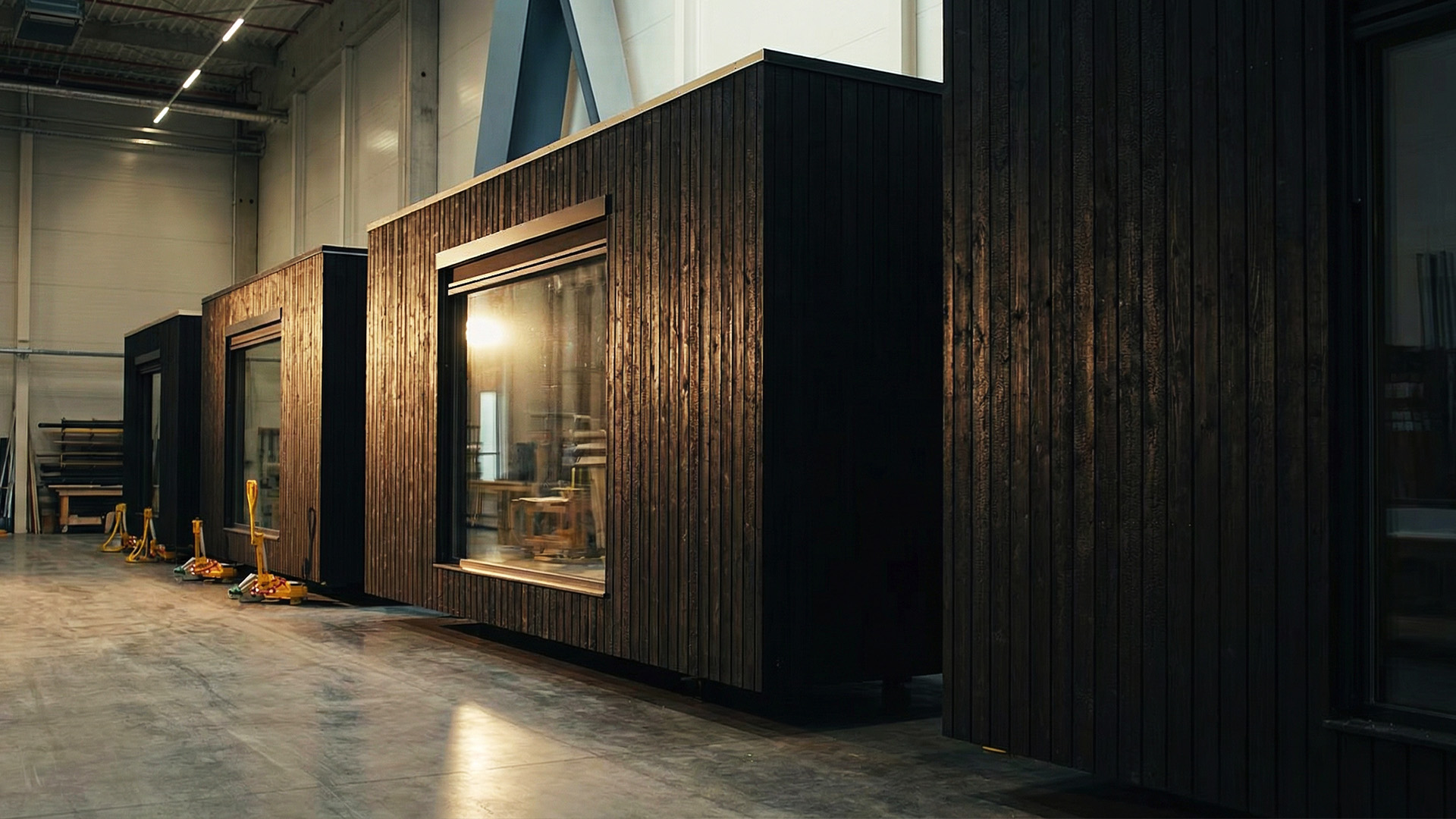
The 21-day production timeline
Conventional Passivhaus construction typically requires 8-12 months on site. Modular production compresses this to 21 days in factory, followed by 2-3 days of site assembly. This timeline reduces weather exposure, labor costs, and the margin for error that extended construction periods introduce.
The certification process
Passivhaus certification proceeds through four distinct phases, each with specific deliverables and verification requirements.
- Design verification. The certifier reviews construction drawings and energy calculations using the Passive House Planning Package (PHPP). This software models predicted performance based on climate data, building geometry, and component specifications.
- Component approval. Critical components—windows, ventilation systems, insulation—must be certified individually by the Passive House Institute or demonstrate equivalent performance through testing.
- Construction inspection. On-site inspections verify that installed components match approved designs and that critical details, particularly air-sealing junctions, meet quality standards.
- Performance testing. Final certification requires passing a blower door test demonstrating air-tightness below 0.6 ACH at 50 Pa. Some certifiers also require thermographic imaging to identify any thermal bridging.
The process typically spans 6-8 weeks from initial design submission to certificate issuance, though timelines vary based on certifier workload and project complexity.
Regional requirements across Germany, Austria, and Romania
While Passivhaus certification follows a unified international standard, regional building codes and incentive programs create different contexts for implementation.
| Requirement | Germany | Austria | Romania |
|---|---|---|---|
| Required by code | Select municipalities | No | No |
| Preferential financing | KfW 40 Plus | Wohnbauförderung | Limited |
| Building permit advantage | Yes | Regional | No |
| Local certifiers | 45+ | 12 | 3 |
In Germany, certain municipalities now require Passivhaus or equivalent performance for new residential construction. Frankfurt, Heidelberg, and portions of Bavaria have implemented such mandates. These requirements accelerate market transformation but also create capacity constraints among qualified contractors.
Austria's generous Wohnbauförderung programs provide substantial subsidies for Passivhaus construction, with some provinces covering up to 35% of additional costs. This makes certified construction effectively cost-neutral in regions with full incentive stacking.
Romania presents the greatest opportunity for differentiation. With only three certified Passivhaus consultants nationwide, demand for expertise significantly exceeds supply. BIOBUILDS maintains our own certification team to ensure consistent delivery regardless of local consultant availability.
Passivhaus certification represents both a technical achievement and a market differentiator. As energy costs rise and regulations tighten, certified buildings will increasingly define the baseline expectation for new construction rather than a premium option. Understanding the standard now positions homeowners and developers to make informed decisions about building for the coming decades.
Frequently Asked Questions
The certification process typically takes 6-8 weeks from initial design submission to certificate issuance. For modular construction, the design phase often runs parallel to production, reducing overall project timelines. BIOBUILDS maintains pre-certified designs that can accelerate this process to 2-3 weeks for standard configurations.
Yes, through the EnerPHit standard designed specifically for retrofits. EnerPHit allows slightly relaxed criteria—20 kWh/m² heating demand versus 15 kWh/m², and 1.0 ACH versus 0.6—acknowledging the constraints of existing construction. Deep energy retrofits achieving EnerPHit certification typically reduce energy consumption by 75-85%.
The certifier identifies leak locations using smoke pencils or thermographic imaging. Remediation typically involves sealing penetrations, improving window installations, or addressing junction details. Retesting occurs after repairs. Factory-built modular homes rarely fail initial testing due to controlled assembly conditions—BIOBUILDS maintains a 98.4% first-attempt pass rate.
While not technically required, mechanical ventilation with heat recovery (MVHR) is present in virtually all certified buildings. The air-tightness requirement makes controlled ventilation essential for indoor air quality, and heat recovery from exhaust air contributes significantly to meeting the heating demand target. Modern MVHR systems recover 85-95% of heat that would otherwise be lost.
Configure Your Passivhaus Home
Start with our interactive configurator. Choose your floor plan, customize finishes, and receive an instant estimate for your certified modular home.
Start Configuring